
 By
By 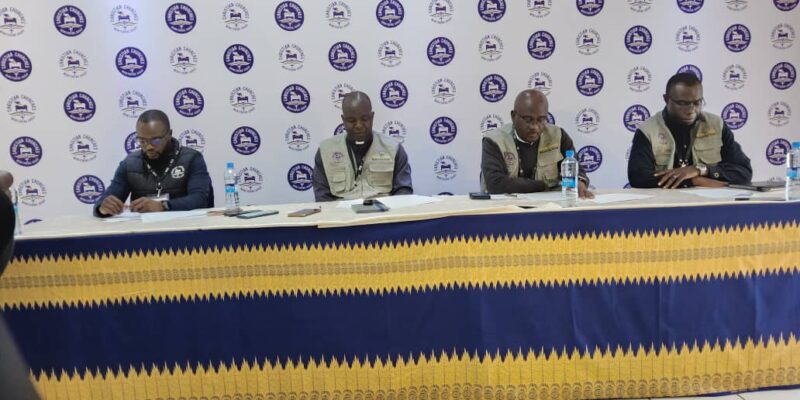
The Christian Churches Monitoring Group (CCMG) has released its preliminary assessment of the 13 August 2026 General Elections, citing transparency in voting but raising serious concerns over pre-election violence, boundary delimitation, and lack of open data.
CCMG claims it deployed 1,500 stationary monitors and 156 mobile monitors on Election Day, with 330 Long-Term Observers covering all constituencies in the pre-election period.
Speaking at a media briefing in Lusaka on Friday, CCMG Steering Committee Chairperson, Father Francis Mukosa, claimed the group received reports from 99 percent of its stationary observers, reportedly totaling over 20,000 reports used to assess the setup, voting, counting, and tabulation processes nationwide.
Mukosa said the group used the Process and Result Verification for Transparency, PRVT, methodology to independently verify the accuracy of official presidential results.
He said while Election Day procedures were largely followed, the pre-election environment presented multiple challenges that affected public confidence in the process.
“CCMG observed several pre-election challenges that impacted the inclusivity and credibility of the process,” Mukosa said.
He said the adoption of the Mixed Member Proportional Representation system and increase in constituencies was done with insufficient consultation and consensus-building and too close to the election, risking voter confusion.
On voter registration, Mukosa reported that the final register stood at 8,786,300 voters, including 4,665,431 women, 4,066,423 youth, and 20,162 persons with disabilities. However, the Electoral Commission of Zambia’s target of 3.5 million new voters was not met, with only 1,762,801 new voters registered.
“CCMG was not provided with a copy of the voters register, making independent verification impossible. Last-minute changes to the timeline also caused confusion among voters and stakeholders,” he said.
Regarding boundary delimitation, Mukosa described the 2026 exercise as a missed opportunity to apply transparent, data-driven criteria.
He noted that ECZ did not release a detailed report on population size by constituency or explain how voter equality was applied when drawing new constituencies.
“The 2026 delimitation undermined the constitutional principle of equal representation and the international standard of ‘one person, one vote’,” Mukosa said.
On Election Day, Mukosa reported that 96 percent of polling stations opened by 7:00hrs, with delays mainly attributed to late arrival of materials.
He also flagged problems with ECZ’s new online-only accreditation system, which it said created undue burdens for organizations with many monitors.
“11 CCMG accredited monitors were initially prevented from observing as presiding officers demanded extra documents. This demonstrates the need for better training of polling officials on the rights of observers,” Mukosa stated.
He said CCMG documented several irregularities during voting and counting, with 77 percent of stations, voters climbing stairs, limiting access for persons with disabilities.
Only claimed that 69 percent of stations had Braille jackets. During counting, 7 percent of stations declared ballots invalid despite the voter intention being clear.
“The process was largely transparent. ID checks, ballot stamping, and the showing of ballots to agents occurred at essentially 100% of stations. However, significant barriers remained for all Zambians, particularly persons with disabilities, to exercise their right to vote,” Mukosa said.
He also reported three critical incidents namely Kalomo Central, where UPND cadres allegedly chased away monitors and agents from other parties during counting and Makeni, armed assailants stormed a polling station at the point of issuing presidential results forms.
He stated that in Masaiti, wrong ballot papers were initially delivered, causing delays.
Addressing ECZ’s suspension of results announcement citing security concerns, Mwape urged broader consultation.
“Such decisions should be made in consultation with all political parties as well as civil society, including nonpartisan citizen observers, to maintain open communications with election stakeholders and the nation to reduce political tensions,” he said.
WARNING! All rights reserved. This material, and other digital content on this website, may not be reproduced, published, broadcast, rewritten or redistributed in whole or in part without prior express permission from ZAMBIA MONITOR.





Comments