
 By
By 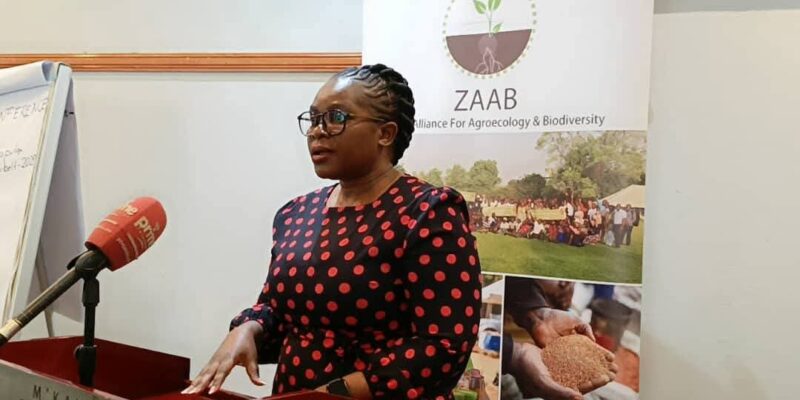
The Zambia Alliance for Agroecology and Biodiversity (ZAAB) has emphasized the need for the government to critically examine the components of the country’s food systems and assess their contribution to climate change, and biodiversity loss.
ZAAB National Coordinator, Mutinta Nketani, raised concern that the country’s reliance on extractive farming practices was not only contributing to food insecurity but also stripping communities of their dignity and traditional identity.
Nketani said this during a food systems dialogue held at Golf View Hotel in Lusaka recently in collaboration with the Mbeza Royal Establishment.
She also emphasized the need for the government to urgently adopt agroecology and traditional land-use practices as a response to growing hunger, climate pressure, and the disintegration of cultural systems in rural communities.
“Our food systems must feed more than bodies. They must also preserve our identity, heal our broken communities, and protect our cultural heritage,” Nketani said.
She warned that Zambia’s current industrial agriculture model was failing to feed the population and undermining cultural integrity and this was posing a danger to the people in various localities
Nketani stated that rural fields were more than food production sites and serve as community centers, spiritual spaces, and repositories of indigenous knowledge.
“When a mother stands beside an empty granary and cannot promise porridge to her hungry child, she is not only facing food insecurity—she is calculating whether to sacrifice her dignity,” she said.
Nketani noted that Zambia once sustained approximately nine million wild animals and one million heards of cattle without exhausting its resources, as a result of well-organized communal grazing systems.
She said the collapse of such systems had led to environmental degradation and disjointed land use and contributed greatly to the current climate change effects.
“Today, we have far fewer animals, yet our land is degraded. The difference is management. There’s no coordination—everyone does what they want. This is how food systems fail,” Nketani said.
Read More: Youths must drive Zambia’s agroecology agenda —Mutinta
During the forum, Chief Nalubamba of the Ila-speaking people of Namwala District, Southern Province, emphasized the need to collaborate in transforming food systems.
The traditional leader noted the need for the process to begin from the food baskets of grandmothers and within cultural expressions such as songlines, rituals, and land-based stories.
Chief Nalubamba warned that Zambia stood to lose its cultural backbone if policymakers continued to ignore indigenous food practices.
Meanwhile, Environmental Advocate and Grassroots Trust Director Rolf Shenton condemned the ongoing destruction of Zambia’s ecosystems, particularly through deforestation and poorly managed grazing.
“Each farming household has the potential to increase productivity and earn ten times more profit by adopting agroecological methods,” Shenton noted.
WARNING! All rights reserved. This material, and other digital content on this website, may not be reproduced, published, broadcast, rewritten or redistributed in whole or in part without prior express permission from ZAMBIA MONITOR.









Comments