
 By
By 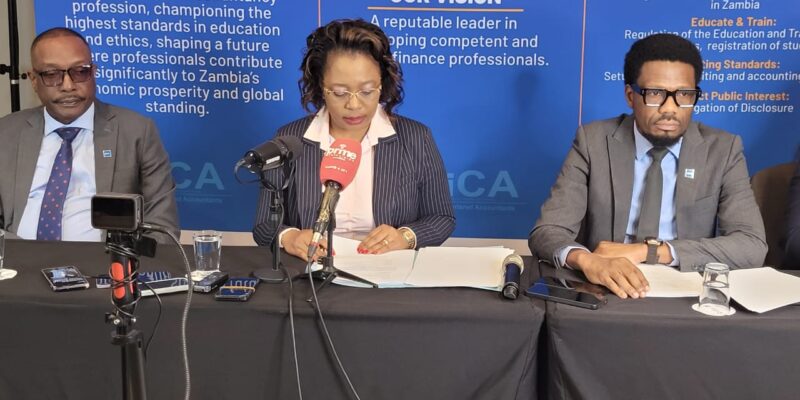
The Zambia Institute of Chartered Accountants (ZICA) has cautioned that the recently amended 2025 borrowing plan, while addressing urgent financing needs, could severely undermine Zambia’s fragile macroeconomic stability.
Speaking during ZICA’s second quarter media briefing in Lusaka on Wednesday, ZICA president, Yande Siame Mwenya, said the plan’s increased reliance on domestic financing and the introduction of foreign currency risked into the domestic debt portfolio carry far-reaching consequences for fiscal discipline, inflation, private sector investment, and the long-term debt burden.
“The most immediate consequence is the potential collapse of the fiscal anchors outlined in the original 2025 national budget,” Mwenya said.
She noted that the Net Domestic Financing (NDF) limit was now expected to rise from 1.9 percent of Gross Domestic Product (GDP) to approximately 3.7 percent—nearly double the initial target.
Read more: ZICA seeks clarity on impact of USAID withdrawal, tariff wars on Zambia
“This represents a substantial fiscal slippage, which, even if attributed to the severe drought, risks damaging the government’s hard-earned credibility,” she warned.
Mwenya also flagged the increased risk of crowding out the private sector from the domestic credit market, as government borrowing intensifies competition for limited domestic savings.
“This has been a persistent concern for ZICA. With domestic credit to the private sector already at a low 12.78 percent of GDP in 2023, further squeezing available capital will drive up borrowing costs and hinder private investment,” she said.
The amendment, recently approved by the National Assembly, raised the NDF ceiling from K15.4 billion to K30.2 billion.
The revised plan allowed the government to borrow an additional K14.84 billion from domestic sources in the 2025 fiscal year.
“This sharp increase in domestic borrowing marks a significant departure from the initial budget, which aimed to cap borrowing to safeguard macroeconomic stability and protect the private sector from being crowded out,” Mwenya said.
She urged government to exercise fiscal prudence and explore more balanced financing options that do not jeopardise long-term economic growth.
WARNING! All rights reserved. This material, and other digital content on this website, may not be reproduced, published, broadcast, rewritten or redistributed in whole or in part without prior express permission from ZAMBIA MONITOR.









Comments