
 By
By 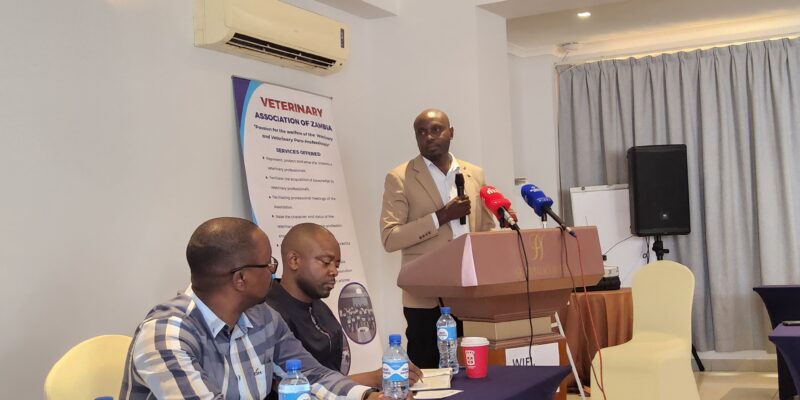
The Veterinary Association of Zambia (VAZ), and the Zambia National Farmers Union (ZNFU) have rejected the proposed Medicines and Allied Substances Draft Bill currently under discussion and called on the government to drop it with immediate effect.
VAZ and ZNFU with support from the Poultry Association of Zambia (PAZ) and the Livestock Association of Zambia (LSAZ) believe that the proposed bill does not adequately address the unique needs and challenges of the veterinary sector.
Speaking at a media briefing held at the Grand Palace Hotel in Lusaka on Thursday, VAZ President, Dr. Malcom Chiyoba, opposed the bill in its current form and advocated for the creation of a separate regulatory authority/directorate for veterinary medicine products and allied substances.
Chiyoba stated that even though this may be viewed as a departure from the one health concept, this was not the case but an opportunity to begin aligning the one health concept to some form of balance as to the institutions within the one health concept.
He argued that further compounding the issue was the lack of local veterinary pharmaceutical manufacturing capacity.
“With heavy dependence on imports, the veterinary sector should rely on a flexible and efficient regulatory process to bridge the supply gap,” Chiyoba said.
He stated that the current framework however offered little support for rapid import approval, resulting in stock-outs and disruptions in animal health care delivery.
Chiyoba said any bill that maintained the current regulatory structure would only worsen the already fragile veterinary supply chain, discouraging investment in local production and innovation.
He stressed the need to establish a separate Veterinary Medicines and Allied Substance Directorate with independent regulatory authority under the Ministry of Fisheries and Livestock and emulate Kenya which runs such a model.
“In the presidential directives pronounced at the official opening of the 80th VAZambia Scientific Conference and Annual General Meeting held on April, 24, 2024 in Livingstone, the President called for decoupling of the veterinary medicines regulation function from the Ministry of Health, to streamline this function,” Chiyoba said.
He emphasized the need to strengthen stakeholder engagement, with a clear inclusion of veterinary professionals and livestock sector industry in regulatory policy-making processes.
Chiyoba stated that the current formulation of the Medicines and Allied Substances Draft Bill fails to recognize the distinct needs of the veterinary sector and risks further marginalizing the industry.
“For Zambia to meet its livestock growth targets, unlock beef export potential, and ensure sustainable animal healthcare, we must adopt a regulatory approach that is fit for purpose,” he said.
Chiyoba said the Association was aware that the Ministry of Fisheries and Livestock suffers severe underfunding , citing the 2026 proposed budget were only K1,854,049,407, representing 1.8 percent of the National Budget.
He stated that from past trends, the actual disbursement was likely to be even less and very late in the budget cycle despite the Ministry being economical and can help the social sectors like Education and Health.
“This low budget allocation must be revised to address among other eminent issues, the employment of veterinary paraprofessionals and veterinary surgeons, improve their conditions of service and address the sloppy regulation of veterinary medicines,” Chiyoba said.
He stated that the separate regulatory authority/directorate, a matter that had been under discussion for a long time but literally nothing happening and being saliently ignored even at the time of the review of the Medicines and Allied Substances Act, was of central importance.
WARNING! All rights reserved. This material, and other digital content on this website, may not be reproduced, published, broadcast, rewritten or redistributed in whole or in part without prior express permission from ZAMBIA MONITOR.







Comments