
 By
By 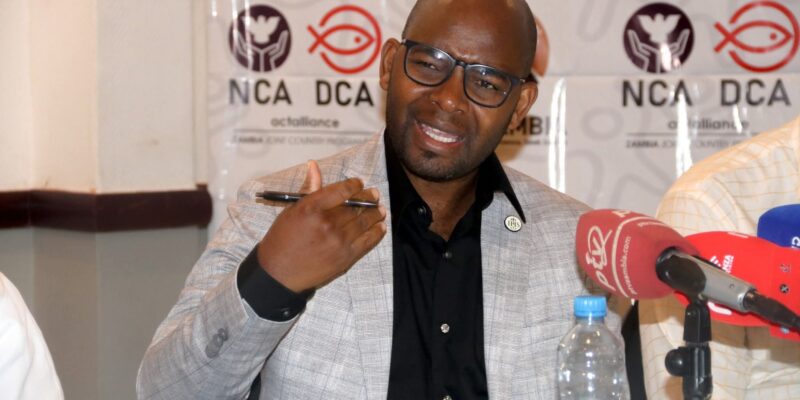
A coalition of Zambian Civil Society Organisations (CSOs) has cautioned that while the government had committed to economic consolidation in the 2026 national budget, the fiscal framework risked deepening inequality and reversing hard-won social progress.
The CSOs said it observed that the budget was framed under the pressure of protracted debt restructuring, the need for high Domestic Resource Mobilisation (DRM), and the political sensitivity of the approaching 2026 General Elections.
Speaking during a joint media briefing in Lusaka on Friday at the Southern Sun Hotel, Southern Africa Cross Borders Traders Association (SACBTA) Secretary-General, Jacob Makambwe, reaffirmed support for measures promoting value addition and green incentives.
Makambwe, however, warned that some tax proposals—such as the rise in the Mobile Money Levy—were regressive and directly penalized low-income earners.
“The levy is seen as a revenue-gaining measure, especially from the untaxed informal sector, to fund about 81% of the budget from local resources,” Makambwe said.
He explained that while the measure sought to capture revenue from the informal economy, it risked discouraging mobile money usage and undermining financial inclusion for the poor and marginalized.
“The Mobile Money Levy should be data-backed to ensure it is not hurting the majority of poor users, although the government may be riding on the potential for tax inelasticity,” he added.
Makambwe further criticized the failure to adjust the PAYE tax-free threshold, saying inflation continues to erode the real income of salaried workers.
“Mining oversight has been drastically cut by 76.7 percent (Mines Safety/Environment), undercutting the environmental sustainability pillar while focusing aggressively on production targets,” he stated.
Jesuit Centre for Theological Reflection (JCTR) Executive Director, Father Daniel Mwamba, described the 2026 budget as a delicate balance between “commendable intent and constrained fiscal capacity.”
“While CSOs affirm the government’s commitment to mass recruitment, sustained social cash transfers, and decentralisation through CDF, the overall fiscal stability is undermined by structural flaws that threaten equity and long-term resilience,” Mwamba said.
He warned that the heavy debt repayment burden was consuming future investments and forcing silent, regressive cuts.
“Formal workers receive no PAYE relief, while the most destitute are overlooked by the drastically reduced welfare target,” he added.
Civil Society for Poverty Reduction (CSPR) Executive Director, Isabel Mukelabai described the 2026 macroeconomic targets as ambitious but structurally constrained by historical debt obligations.
Read More: Musokotwane unveils tax reliefs, duty reforms to spur local industries in 2026 budget
“Despite an improved macroeconomic outlook, the challenge is ensuring that stability translates into genuine poverty reduction and inclusive growth, as Zambia continues to face persistent inequality and vulnerability to external and climate shocks,” she said.
The Zambia Alliance for Women (ZAW) commended government’s commitment to social safety nets but noted that allocations remained below international and national poverty reduction standards, particularly in the WASH and welfare sectors.
Meanwhile, Transparency International Zambia (TIZ) said that while it supported decentralisation, key institutional and accountability functions necessary for good governance remained underfunded.
The signatory CSOs urged the National Assembly and the Ministry of Finance and National Planning to implement structural adjustments to the 2026 Budget Estimates to safeguard national resilience and ensure inclusive growth.
The coalition included JCTR, CSPR, TIZ, Centre for Trade Policy and Development (CTPD), Southern Africa Cross Border Traders Association (SACBTA), Zambian Empowerment Hub for Entrepreneurship and Skills Training (ZEHEST), Zambia Alliance for Women (ZAW), CSO Debt Alliance, and Lift Zambia.
WARNING! All rights reserved. This material, and other digital content on this website, may not be reproduced, published, broadcast, rewritten or redistributed in whole or in part without prior express permission from ZAMBIA MONITOR.








Comments