
 By
By 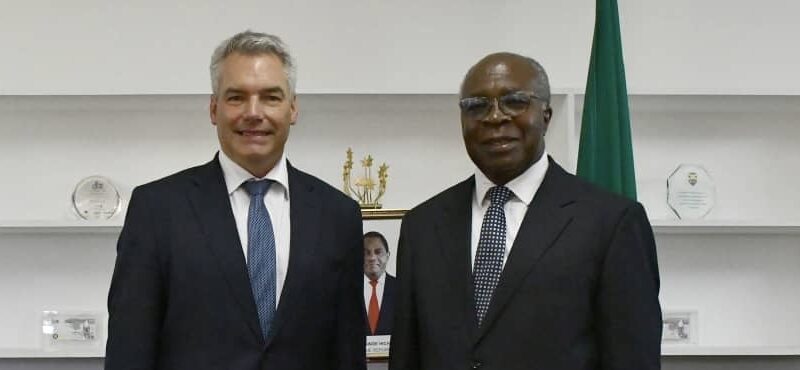
Zambia and the European Investment Bank (EIB) have held high-level discussions to strengthen cooperation in infrastructure investment and trade, with particular focus on the Lobito Corridor — a strategic regional transport route linking Zambia to the Atlantic Ocean through Angola.
Finance and National Planning Minister, Dr. Situmbeko Musokotwane, met with EIB Vice President, Karl Nehammer on the sidelines of the Zambia–European Union Lobito Corridor Business Forum, which runs from November 12 to 14, 2025, in Lusaka.
The bilateral meeting advanced Zambia’s efforts to deepen partnerships with multilateral development institutions in support of its infrastructure-led growth strategy, regional trade integration, and private-sector-driven development agenda.
The talks centred on the EIB’s role in the Lobito Corridor Development Project, a joint initiative involving Angola, the Democratic Republic of Congo, and Zambia.
According to a statement, the project aligns with Zambia’s industrialisation and connectivity framework, which seeks to transform the corridor into a modern trade artery connecting the country to the Atlantic coast.
Musokotwane said the Lobito Corridor remained a cornerstone of Zambia’s economic transformation agenda and an important avenue for boosting cargo movement, stimulating regional trade, and accelerating industrial growth.
“The Lobito Corridor presents major investment opportunities to expand Zambia’s export capacity and deepen regional economic integration.
“Our goal is to build an efficient trade route that supports mining, manufacturing, and agriculture—while unlocking value for citizens and investors alike,” he said.
Musokotwane explained that the government’s priority was to expand mining and export capacity to increase freight volumes, enhance industrial competitiveness through value addition, and strengthen rural economies by promoting agro-processing and agricultural productivity.
The Minister reaffirmed government’s commitment to Public–Private Partnership models as a key mechanism for mobilising private capital to finance major infrastructure projects.
Ongoing feasibility studies, he noted, would help identify financing gaps and opportunities for targeted interventions.
Nehammer reiterated EIB’s support for Zambia’s infrastructure and trade ambitions, stating that the Bank was ready to work with the government and regional partners to strengthen connectivity, improve logistics, and unlock the Lobito Corridor’s full economic potential.
The EIB remains one of Zambia’s key multilateral partners, with an active portfolio valued at US$ 536.4 million as of June 2025.
The portfolio, which spans transport, energy, and water and sanitation sectors, underscores the Bank’s continued confidence in Zambia’s reform trajectory.
Major EIB-financed projects include the Great North Road (T2) upgrade, the Lusaka Power Transmission and Distribution Project, and the Lusaka Sanitation Project, all of which support the objectives of the Eighth National Development Plan (8NDP) to enhance connectivity and sustainable growth.
Musokotwane expressed appreciation for EIB’s continued confidence and collaboration, noting that as Zambia transitions from stabilisation to growth, partnerships with institutions such as the EIB remain critical to sustaining fiscal and structural reforms.
He added that the government was ready to implement bankable projects under the Lobito Corridor and other national initiatives designed to strengthen Zambia’s position as a reform-driven and resilient economy at the heart of Southern Africa.
The meeting comes at a pivotal moment in Zambia’s reform and investment drive and signals to international markets that the country’s partnerships with multilateral lenders remain robust and expanding.
EIB’s engagement also complements ongoing reforms supported by the IMF and World Bank, anchoring Zambia’s transition toward sustainable, inclusive growth through strategic infrastructure development and regional integration.
WARNING! All rights reserved. This material, and other digital content on this website, may not be reproduced, published, broadcast, rewritten or redistributed in whole or in part without prior express permission from ZAMBIA MONITOR.









Comments