
 By
By 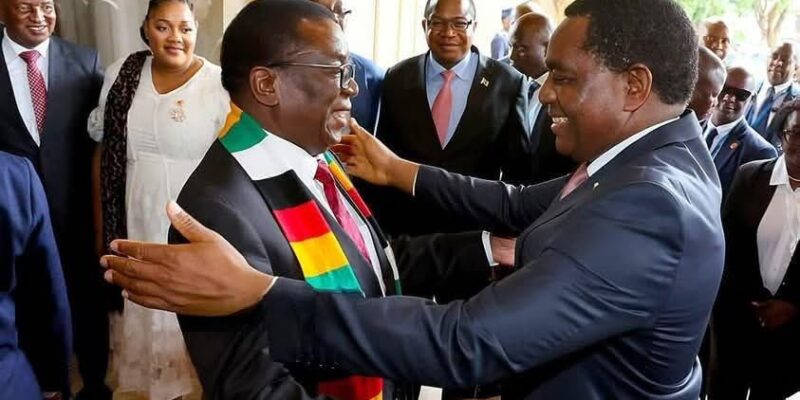
Zambia and Zimbabwe have signed five agreements on economic cooperation, diplomatic training, and other areas following a meeting between President Hakainde Hichilema and Zimbabwean President Dr. Emmerson Mnangagwa.
The agreements cover diplomatic training; immigration and technical cooperation in labour and employment, agriculture, and youth development.
The two countries also agreed to expedite consultations and finalise all outstanding agreements, aiming to sign them at the Mid-Term Review of the Inaugural Bi-National Commission.
The agreements were signed in Harare, Zimbabwe, during President Hichilema’s working visit on November 14, 2025, at the invitation of President Mnangagwa.
According to a communique issued in Lusaka on Friday by the Ministry of Foreign Affairs and International Cooperation, the meeting reaffirmed the longstanding ties of solidarity, friendship, and mutually beneficial cooperation between the two nations.
The Zimbabwean delegation was led by President Mnangagwa, who was accompanied by Minister of Foreign Affairs and International Trade Professor Amon Murwira, other ministers, and senior government officials.
The Zambian delegation was led by President Hichilema, accompanied by Minister of Foreign Affairs and International Cooperation Mulambo Haimbe, other ministers, and senior government officials.
“The Parties agreed to maintain regular engagements and intensify collaboration across existing and emerging areas of mutual interest,” reads the communique.
The two countries further underscored the importance of sustained dialogue on bilateral, regional, continental, and global developments, with a view to advancing shared positions and strengthening strategic alignment.
The parties welcomed the proposal to hold the Second Session of the Bi-National Commission, agreeing to convene it by November 2027 in Lusaka, Zambia.
Zambia pledged to continue advocating for the removal of illegal and unilateral sanctions imposed on Zimbabwe, which are hindering developmental efforts.
“The Parties reaffirmed their commitment to continue cooperating in the promotion and sustenance of peace and security between the two countries and at regional, continental and global levels,” the communique said.
On border management, the Surveyors General of both countries were commended for their continued cooperation and progress in the boundary reaffirmation exercise.
The parties were encouraged to sustain reconnaissance efforts along the common boundary, from Victoria Falls to the Kazungula area.
To enhance visibility and facilitate monitoring, the parties agreed to install floating buoys along Lake Kariba, marking the boundary with greater clarity.
Both countries committed to consolidating their already excellent relations and agreed to a 24-hour operation of the Chirundu and Victoria Falls One Stop Border Posts by 31 December 2025.
“The Parties recalled the decision of the MTR of September 2025, to remove all barriers that affect trade,” reads part of the communique.
Zimbabwe informed the meeting that its Cabinet had passed a decision to scrap transit duties on petroleum products, and measures on other barriers were factored into the country’s 2026 National Budget, effective 27 November 2025.
Both sides agreed that technical-level discussions on the matter would continue quarterly, with finalisation by 31 March 2026.
Read More: SADC reaffirms solidarity, calls for immediate lifting of sanctions on Zimbabwe
The parties also agreed to initiate the drafting of a bilateral Trade and Economic Cooperation Framework Agreement, anchored on existing regional and continental instruments, to guide structured engagement and deepen economic ties.
“Progress under the Simplified Trade Regime (STR) was acknowledged, with both Parties reaffirming their commitment to its full implementation to facilitate small-scale cross-border trade,” reads the communique.
The parties welcomed arrangements to support electricity imports by Zambia through Zimbabwe, with Zimbabwe progressively increasing the limit on power transfer capacity.
The two countries also underscored the importance of enhancing transport connectivity as a crucial driver for trade and investment.
“The Parties further acknowledged the importance of continuous collaboration to ensure that shared assets are commercially viable and utilised to the benefit of communities and peoples,” according to the communique.
WARNING! All rights reserved. This material, and other digital content on this website, may not be reproduced, published, broadcast, rewritten or redistributed in whole or in part without prior express permission from ZAMBIA MONITOR.








Comments