
 By
By 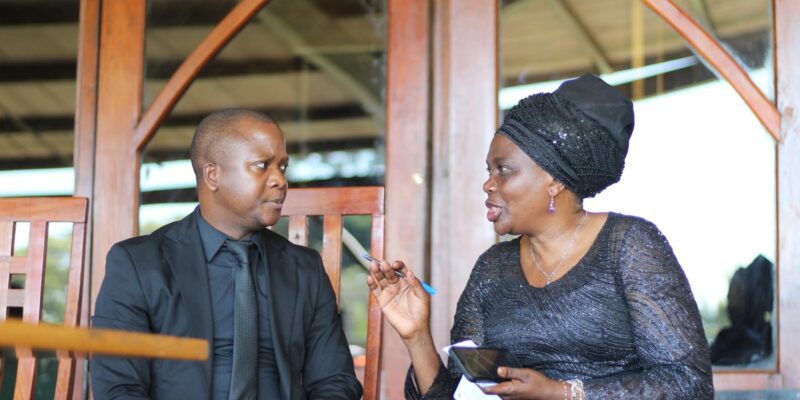
The Oasis Forum has condemned Zambian government’s decision to suspend dialogue on the constitutional amendment process and its refusal to consider withdrawing Bill 7 or providing legally sound alternatives, describing the move as a serious threat to Zambia’s foundational law and a potential trigger for anarchy.
The Forum said it decided to pull out of the dialogue after it became clear that the government remained adamant on pursuing what it considers an illegal process.
Beauty Katebe, Oasis Forum Chairperson, said the government’s approach showed an apparent lack of interest in genuine, people-driven dialogue and called on all Zambians to defend constitutionalism, the rule of law, and good governance.
“It is for this reason that on November 29, 2025, following its sitting, the Oasis Forum wrote to the President t communicate its principled stance on the matter, which letter was delivered to the smaller team representing the Government on 30th November, 2025,” Katebe said.
She argued that dialogue was untenable while underlying concerns—such as the illegality of the process and breach of Constitutional Court orders—remained unaddressed.
Katebe said continuing with Bill 7 effectively rubber-stamped a process that the Constitutional Court declared null due to the lack of mandatory broad public consultations in framing the proposed amendments.
“The report and ensuing Bill from the work of the Technical Committee will itself be illegal. Lack of Legal Framework and Independence,” she said, adding that the Technical Committee’s work lacked a legal framework to ensure independence and public accountability, risking undue executive influence over what should be a citizen-driven process.
She criticized the restrictive Terms of Reference (TOR) prescribed by the government, which limited citizens’ submissions to clauses in Bill 7, effectively resurrecting an illegitimate, election-centred agenda and precluding holistic reform.
“Despite the Constitutional Court nullifying the initiation of Bill No. 7 of 2025, the Bill remains before the National Assembly, further entrenching an illegitimate process,” Katebe said.
She also argued that rushing the reform process to align with the 2026 General Elections compromised inclusivity and national consensus, diverting attention from urgent issues such as the cost of living, water shortages, and unemployment.
“There is no justification for amending the supreme law of the land in a rushed manner, less than 30 days, as though there is no tomorrow,” she said.
Katebe noted that despite presenting these unresolved concerns, including during a meeting with the President, the dialogue yielded no progress.
“The government remains bent on proceeding with the current illegal and flawed process and has refused to withdraw Bill No. 7 from Parliament formally,” she said, reaffirming the Forum’s precondition that Bill 7 must be formally withdrawn for any meaningful dialogue to continue.
She called for a fresh constitutional reform process, supported by legal safeguards, genuinely inclusive, holistic, and not rushed.
“Should these be attended to by Government, we remain available to return to the dialogue table. We urge members of the public to join the Campaign against Bill 7, which the Oasis Forum will roll out,” Katebe added.
On Sunday, the government’s decision to suspend dialogue with the Oasis Forum had added a new layer of tension to the constitutional reform process, exposing widening differences in how the two sides interpret “genuine engagement” and the expectations surrounding national consensus-building.
The talks, led earlier in the day by Attorney General Mulilo Kabesha, were expected to build on the meeting President Hakainde Hichilema held with the Forum on Friday, 28th November 2025.
That high-level engagement at State House had been framed as a confidence-building step meant to draw civil society into the reform process and demonstrate the administration’s openness to dissenting voices.
But the optimism proved short-lived.
Government officials said the Oasis Forum arrived with a closed position and “unwillingness to engage constructively,” pointing to a letter submitted by the Forum dated 29th November as evidence that the civil society coalition was not prepared to proceed with what State House considers sincere dialogue.
Officials also argued that the Forum did not identify specific problematic clauses in the reform proposals nor offer alternative suggestions — a key requirement, they say, for any discussions to move toward consensus.
WARNING! All rights reserved. This material, and other digital content on this website, may not be reproduced, published, broadcast, rewritten or redistributed in whole or in part without prior express permission from ZAMBIA MONITOR.









Comments