
 By
By 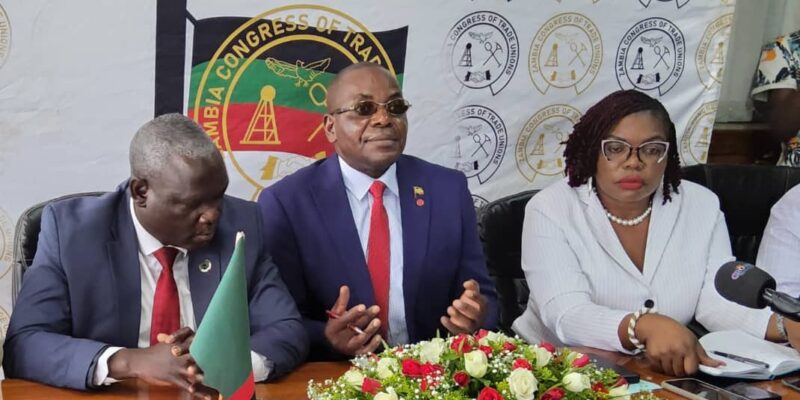
The Zambia Congress of Trade Unions (ZCTU) says collective bargaining in 2025 has become increasingly constrained, particularly in the public service, due to restrictive government directives that have narrowed negotiations and weakened workers’ ability to cope with rising living costs.
ZCTU President, Blake Mulala, said bargaining outcomes had often failed to reflect inflation, productivity and cost-of-living realities, resulting in growing frustration, low morale and declining trust in negotiation processes.
Speaking during an end-of-year media briefing in Lusaka, Mulala warned against using fiscal discipline to undermine labour rights.
“Collective bargaining must remain free and conducted in good faith, warning that fiscal discipline should not be used to suspend workers’ constitutional and international labour rights,” he said.
Turning to pensions, Mulala said workers continued to struggle even after retirement despite years of contributions, noting that the absence of a lump-sum payment option had left many retirees unable to meet immediate needs such as housing and medical care.
“Delays in reforming the National Pension Scheme Authority had weakened confidence in the social security system, reinforcing workers’ fears about income security after retirement,” Mulala said.
He stressed that pension funds should serve contributors rather than institutional rigidity, arguing that meaningful reform was essential if economic gains were to benefit workers throughout their lives.
Mulala also raised concern over violations of the right to organise, particularly in the private sector. He cited continued intimidation, casual contracts and union-busting in the hospitality industry, while agricultural workers were denied union access and paid below the minimum wage.
“Such practices deepened exploitation and reinforced inequality, adding that economic growth built on silenced labour could not be considered inclusive,” he said.
He called on government to strengthen labour inspections and enforce sanctions, stressing that workers’ rights must be protected for economic gains to have real meaning.
On public service negotiations, Mulala said workers had exercised patience as talks continued, noting that ZCTU had engaged government at the highest level and remained hopeful for positive outcomes, while warning that prolonged delays only compound financial stress.
Addressing corruption, Mulala said the abuse of public resources continued to undermine service delivery and public trust, with workers ultimately bearing the cost through poor services and lost opportunities.
He urged investigative institutions to act independently, recover misappropriated funds and ensure accountability without political interference.
On health, Mulala said workers continued to struggle to access quality services despite contributing to the National Health Insurance Management Authority (NHIMA), citing governance challenges that have weakened confidence in the scheme.
“The failure to reconstitute the NHIMA Board had undermined accountability and stakeholder trust, stressing that workers, as the main contributors, must be central to its governance,” Mulala stated.
On the energy sector, Mulala described the electricity crisis as one of the most damaging challenges to workers and livelihoods in 2025, citing reduced production, job losses and high generator costs affecting industries and small businesses.
“Households had also suffered through disrupted education, health risks and higher living costs, further eroding the benefits of any economic gains,” he said.
While acknowledging government efforts to improve power supply and expand generation capacity, Mulala said the situation remained unsustainable and continues to weigh heavily on workers.
He further observed that workers continued to struggle despite reported macroeconomic gains, warning that rising living costs, weak social dialogue and job insecurity remained major threats to livelihoods.
Read More: ZCTU condemns Chingola violence as as FDD faults government over unrest
“While government has highlighted improvements such as debt restructuring and engagement with international financial institutions, these gains have not translated into better living and working conditions for the majority of Zambian workers,” Mulala said.
He added that the assessment was based on the daily realities faced by workers across all sectors who sustain families and keep public and private institutions running under difficult conditions.
“The statement was not partisan but a workers’ accountability scorecard on governance, the economy, labour rights and public service delivery, reflecting the gap between economic indicators and lived realities,” Mulala said.
Looking ahead to 2026, Mulala said workers expected stronger social dialogue, respect for collective bargaining, protection of the right to organise, pension reforms, functional NHIMA governance, reliable electricity supply and economic growth that improves livelihoods.
He said workers remained committed to national development but warned that without tangible improvements in living and working conditions, economic gains would remain out of reach for the majority.
WARNING! All rights reserved. This material, and other digital content on this website, may not be reproduced, published, broadcast, rewritten or redistributed in whole or in part without prior express permission from ZAMBIA MONITOR.





Comments