
 By
By 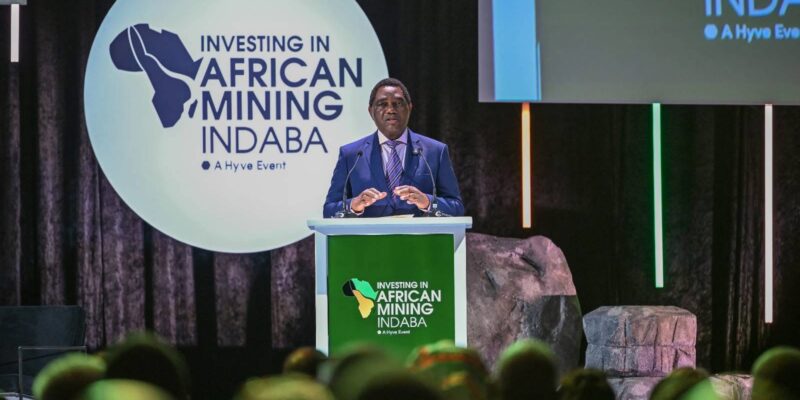
President Hakainde Hichilema on Monday urged African countries to deepen collaboration on mineral governance, saying the continent’s resources underpinned daily life and global technologies but were often taken for granted.
“Every time you switch on a light, use your phone, drive a car, board a plane or rely on the internet, you are using minerals,” Hichilema said at the Investing in African Mining Indaba in Cape Town.
“Many times we take these resources for granted until we truly examine how minerals facilitate our normal lives,” he said
Hichilema commended South Africa and its minerals minister, Gwede Mantashe, for pushing continental cooperation.
“It is true that Africa must collaborate more. Yes, we have individual national interests, but they are building blocks. We are stronger together,” he said.
The president added that Africa’s collective capabilities—skills, experience and resource endowments—positioned the continent to derive far greater value from its minerals if countries coordinate policies and prioritise beneficiation.
“Value addition must become part of the agenda, not just for governments but also for mining companies and service providers,” he said. “When our countries succeed, our economies grow and that stability benefits the operating environment, ” he added.
Hichilema outlined Zambia’s reform programme, saying his administration had focused on restoring economic stability and investor confidence after inheriting debt distress, litigation across the mining sector and an economy that had recently contracted 2.8 percent.
“Our reforms are anchored in stability, confidence-building, clarity and consistency. Zambia is now on a growth trajectory, with the economy expected to expand around 6.4% this year, a sharp turnaround from deep contraction four years ago,” ” he said.
He noted that inflation had fallen from more than 22% to single digits, while investment had returned to the mining sector. “Since 2022, more than US$12 billion has been invested,” he said, citing major commitments by First Quantum Minerals, Barrick, Mopani Copper Mines, CNMC and others.
According to him, Zambia had also revived previously defunct mines, including Konkola and Mopani operations, and expects copper output to reach 1 million tonnes this year, a first for the country, with a long-term target of 3 million tonnes.
Hichilema said Zambia had stabilised relations with the International Monetary Fund (IMF) by insisting on a “Zambia-designed programme,” adding: “Africa must change the narrative that others design programmes for us. We must decide what we want.”
Hichilema said Zambia was conducting its first high-resolution geophysical survey in 50 years to map national mineral potential, calling it an investment in “de-risking exploration” and improving capital allocation.
He emphasised new institutions such as the Minerals Regulation Commission and a Mines Appeals Tribunal, aimed at streamlining licensing and reducing disputes. “We are rooting out inconsistencies and creating clarity for investors,” he said.
On local content, Hichilema said Zambia had legislated to ensure small businesses participated more directly in mining supply chains. “Inclusion creates vested interest. It is an insurance policy against negative behaviours such as expropriation,” he said.
Zambia’s reforms, he added, were delivering visible benefits, including the revival of towns affected by mine closures and increased government revenue for social programmes. He cited mining revenues that had helped fund free education and return 2.3 million children to school.
Hichilema urged African leaders and mining executives to move away from the historical pattern of exporting raw materials.
“Africa should not continue exporting raw minerals as its main business. That mindset must change,” he said. “We have the resources, the capabilities and the need. Now we must collaborate and act.”
He said Zambia’s commitment to beneficiation was clear, citing the planned expansion of First Quantum’s smelter and ongoing policy work to support processing of copper, cobalt and other critical minerals.
“There is nothing special about Zambia. It is the way we see things—working together, government and business, for a shared agenda. That is how we succeed,” Hichilema said.
WARNING! All rights reserved. This material, and other digital content on this website, may not be reproduced, published, broadcast, rewritten or redistributed in whole or in part without prior express permission from ZAMBIA MONITOR.





Comments