
 By
By 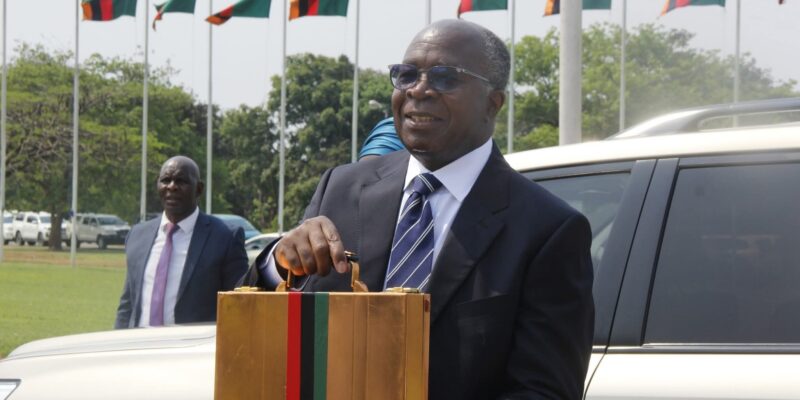
Finance and National Planning Minister, Situmbeko Musokotwane, has presented a record-breaking national budget of K253.1 billion for 2026, a fiscal plan that not only sets a new spending benchmark but also reflects the political weight of an election year.
The budget, which rises from K217.1 billion in 2025, is anchored on domestic resource mobilisation.
Musokotwane told Parliament that K206.5 billion would come from domestic revenues, making up 81.6 percent of the budget and the equivalent of 22.3 percent of Gross Domestic Product (GDP).
The heavy reliance on local revenues shows government’s strategy to strengthen fiscal sovereignty and reduce external dependence, though it also places more responsibility on taxpayers and businesses to sustain public expenditure.
Grants from cooperating partners are projected at K12.1 billion, or 4.8 percent of the budget, while the remaining K34.5 billion—3.7 percent of GDP—will be financed through domestic and external borrowing.
Read more: Chisanga tells govt to ensure 2026 budget balances growth, social priorities, with fiscal discipline
These figures highlight Zambia’s balancing act: seeking to limit debt accumulation while still depending on borrowing to close financing gaps.
Musokotwane proposed a range of tax adjustments to underpin this plan.
These include higher citizenship and visa fees, firearm fees, mobile money levies, and tolls for larger vehicles, with exemptions for smaller cars, light vehicles, and buses.
“Some of these measures are intended to recover revenue from those who avoid paying taxes,” he said, signalling an attempt to capture revenue from previously under-taxed segments of the economy.
The introduction of a 30 percent excise duty on firearms and ammunition, alongside harmonising customs duty on firearms at 25 percent, shows government’s willingness to use taxation not just for revenue but also for regulatory purposes.
Excluding buses with a seating capacity of 50 or more from presumptive tax and shifting them to turnover or corporate tax brings another layer of formalisation into transport taxation.
On expenditure, the budget strongly emphasises social protection and infrastructure, areas that carry both developmental and political significance.
The Food Security Pack will see its allocation rise to K1.5 billion from K1.2 billion, broadening its reach to vulnerable households.
Health infrastructure has been allocated K1.7 billion, a signal that government is keen to be seen investing in long-term access to essential services.
At the heart of the spending plan lies K15.7 billion for social protection, including K7.6 billion for the Social Cash Transfer Programme and K4.9 billion for pension payments.
These programmes provide immediate relief to poor families and retirees, but in an election year, they also carry strong political resonance, allowing government to demonstrate responsiveness to social needs.
The focus on roads, bridges, and social transfers is in keeping with what analysts often call “visible projects”—investments that can be easily showcased to voters in the short term.
The allocation of K1.2 billion for the conduct of the 2026 general elections further reflects how next year’s polls shape the fiscal framework.
Overall, while the record K253.1 billion budget speaks to Zambia’s ambition to expand spending and deliver on social commitments, it also reveals a calculated balance between economic necessity and political timing.
The numbers, in this sense, tell a story not just of fiscal planning but of electoral strategy.
WARNING! All rights reserved. This material, and other digital content on this website, may not be reproduced, published, broadcast, rewritten or redistributed in whole or in part without prior express permission from ZAMBIA MONITOR.




Comments