
 By
By 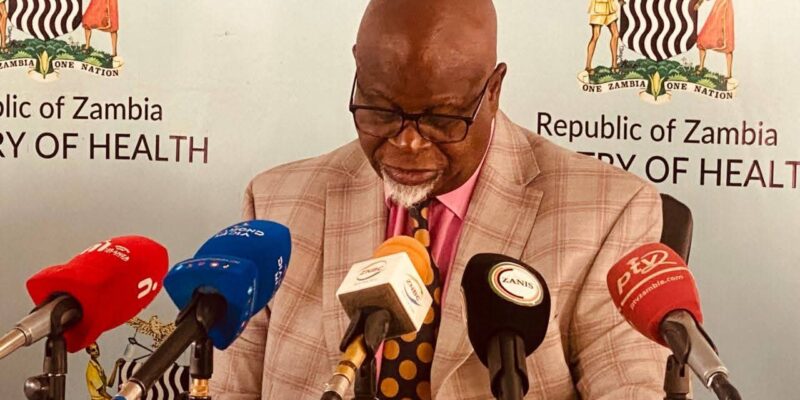
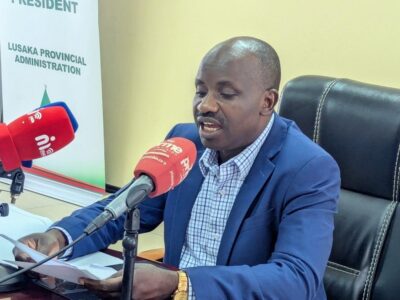
Health Minister, Dr. Elijah Muchima, has raised concern over the rise in cholera cases in Lusaka Province, which he says has now become the primary focus of transmission, with “low-level, geographically widespread sporadic cases across multiple sub-districts.”
Muchima said seven districts continue to experience active cholera transmission.
These included Mpulungu (second wave), Lusaka, Chilanga, Nakonde, Solwezi (second wave), Nkeyema and Choma.
Speaking during a media briefing in Lusaka on Monday, he noted that the province continued to record cases in health facilities, despite several districts countrywide meeting the 28-day zero-reporting threshold.
He revealed that in the last 24 hours, 20 new cholera cases had been recorded from four districts—Lusaka with 11, Mpulungu with 2, Nakonde with 4, and Choma with 3—adding that no deaths were reported in that period.
“The three cases in Choma confirm a new outbreak, increasing the number of active outbreak districts to seven and making Choma the third affected district in Southern Province, nearly 70 days after the last case was reported in Monze,” Muchima said.
He added that Lusaka District alone had recorded 170 cumulative cases and two deaths, giving a case fatality rate of about 1.2 percent, and confirming the district’s role as the current driver of national transmission.
Muchima also highlighted that Nakonde District, despite reporting fewer cases, had recorded a disproportionately high case fatality rate, indicating late detection and community-level vulnerabilities.
“These are being addressed through intensified surveillance, community engagement, and support to frontline health workers,” he said.
As part of the response, the Minister revealed that the Ministry of Health and its partners had so far deployed and administered two doses of the oral cholera vaccine to at-risk populations in Chainda to supplement other high-level interventions.
Dose 1 targeted 35,700 eligible individuals, of whom 35,396 (99.1 percent) were reached. Out of those vaccinated with the first dose, 32,987 (93.2 percent) have so far received Dose 2.
“In order to attain maximum protection of the eligible recipients, the Ministry is scheduled to administer dose 3 from February 17 to 22, 2026,” Muchima stated.
He appealed to residents of Chainda in Lusaka to ensure they complete the full vaccination course for maximum protection.
Muchima recalled that Zambia had been responding to the cholera outbreak first detected on August 5, 2025, in Mpulungu District of Northern Province. Since then, 20 districts across eight provinces have reported cases.
“Luapula and Eastern Provinces have remained free of confirmed cholera cases throughout this period. As of 3 February 2026, the country has recorded a cumulative total of 861 cholera cases and 16 deaths,” Muchima said.
He added that seven deaths occurred in health facilities while nine were recorded in community settings, stressing the importance of early symptom recognition and prompt care-seeking.
Muchima said Northern Province—particularly Mpulungu—remained the epicentre, accounting for about 70 percent of cases, with 570 recorded across five districts.
“Transmission in this region has been prolonged, with periods of decline followed by resurgences, including a second wave in Mpulungu,” he said.
He attributed the pattern to residual environmental contamination, cross-border movement, fishing-related activities, and persistent gaps in water, sanitation and hygiene.
Muchima added that from November 2025, transmission had shifted southwards and become more centralised, with outbreaks detected in Monze and later Lusaka Province, reflecting spread linked to population mobility, informal settlements, and sanitation challenges.
Read More: Government moves to contain cholera outbreak in Mpulungu, Mbala
Muchima announced that from January 2025 to date, Zambia had recorded 2,549 suspected measles cases. Samples collected from 1,109 individuals confirmed 243 cases, representing a positivity rate of 22 percent.
“In 2025, most suspected cases were reported from Mungwi, Chiengi, Mwinilunga, Luampa, Ikelenge, Kanchibiya, and Chavuma Districts,” he said.
He added that measles cases in 2026 remain low, with sporadic cases in Lusaka, Chitambo, and Mushindamo, signalling the need for sustained vigilance and better specimen referral.
On Mpox, the Minister said that since the beginning of 2024, Zambia had recorded 2,261 suspected and 399 laboratory-confirmed cases, with three deaths—representing a case fatality rate of 0.8 percent.
Concerning the WHO-announced Global Health Alert for the Nipah Virus, Muchima said Zambia continued to strengthen preparedness through a proactive, multi-sectoral approach.
“A national readiness assessment is underway in accordance with the International Health Regulations, and the Ministry would like to assure the country that we have the laboratory capacity to detect Nipah virus through our national viral surveillance platform,” he said.
WARNING! All rights reserved. This material, and other digital content on this website, may not be reproduced, published, broadcast, rewritten or redistributed in whole or in part without prior express permission from ZAMBIA MONITOR.







Comments