
 By
By 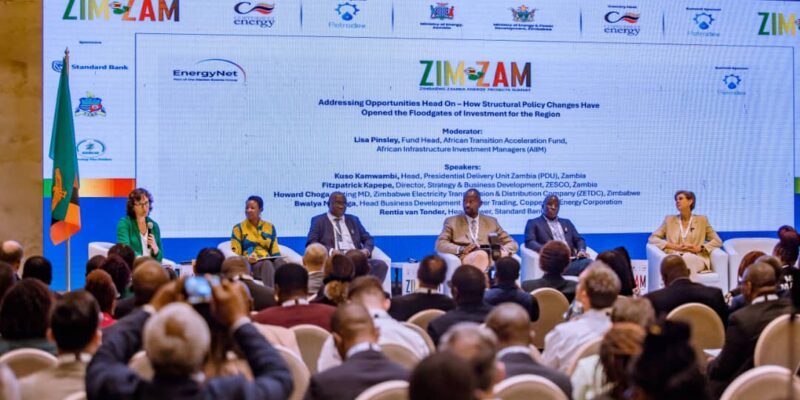
The Zimbabwe–Zambia Energy Projects Summit (ZimZam 2025) opened on Wednesday in Livingstone, signalling a renewed commitment to regional energy cooperation and private-sector investment in Southern Africa.
Held at the Radisson Blu Mosi-Oa-Tunya Livingstone Resort under the theme “Mines and Energy: How Stakeholders Have Fast-Tracked Private Sector Projects to Become Africa’s Top Investment Destination,” the three-day summit convened senior officials from Zambia and Zimbabwe, representatives of the African Union (AU) and the Southern African Development Community (SADC), and key private-sector players including Copperbelt Energy Corporation (CEC), ZESCO, Standard Bank, and Petrodex.
Southern Province Minister, Credo Nanjuwa, set a clear tone for the summit, emphasising action over rhetoric.
“Your presence affirms the importance of this summit as a regional platform for investment, innovation and strategic collaboration. This summit must never become a talk show. Our citizens, industries and economies need results, not empty promises,” he said.
Zimbabwe’s Deputy Minister of Energy and Power Development, Yeukai Simbanegavi, echoed the call for deeper cross-border collaboration, noting that persistent energy challenges had underscored the interdependence between the two countries.
“As Zimbabwe transitions to NDS2, more private sector investments are expected in the electricity sector, supported by reforms and incentives that promote ease of doing business,” she said.
Private-sector stakeholders highlighted the central role of investment and infrastructure in unlocking regional potential. Monie Captan, Deputy Chief Executive Officer of Petrodex West Africa, stressed the transformative potential of regional power trading:
“Regional power trading will be the next major catalyst for growth, connecting surplus and deficit markets through modern infrastructure and innovation,” Captan said.
Standard Bank Zambia added a financial dimension to the discussions, underscoring the importance of instruments that mobilise both public and private capital.
“Zambia’s mining and energy sectors are not just delivering economic value – they’re driving transformation. We are eager to collaborate with key stakeholders and co-create solutions that elevate the region to its next frontier,” said Helen Lubamba, Head of Corporate and Investment Banking at Stanbic Bank Zambia.
Institutional frameworks were also a focus. The African Union Commission began high-level consultations on the Grand Inga Strategic Coordination Committee, advancing work on Africa’s flagship 44-GW Grand Inga Hydropower Project under the AU’s Agenda 2063.
Meanwhile, SADC and the United Nations Economic Commission for Africa (ECA) conducted sessions on the Draft SADC Just Energy Transition Framework, aimed at ensuring universal access to affordable and clean energy by 2050.
“These programmes highlight how regional cooperation can move from ambition to implementation,” said Mavis Mwapeof the SADC Secretariat.
On the Zambian side, ZESCO Managing Director, Justin Loongo, presented regulatory reforms that have strengthened investor confidence, including open access policies and predictable tariff structures.
“Through open access and predictable tariffs, we’ve created an environment where public and private partners can deliver real progress,” he said.
With broad representation from government, regional institutions, and private investors, the opening day set the stage for in-depth discussions on financing the SADC Just Energy Transition Framework, expanding renewable energy capacity, and strengthening cross-border power infrastructure, signalling a deliberate move from discussion to implementation in Southern Africa’s energy sector.
WARNING! All rights reserved. This material, and other digital content on this website, may not be reproduced, published, broadcast, rewritten or redistributed in whole or in part without prior express permission from ZAMBIA MONITOR.





Comments