
 By
By 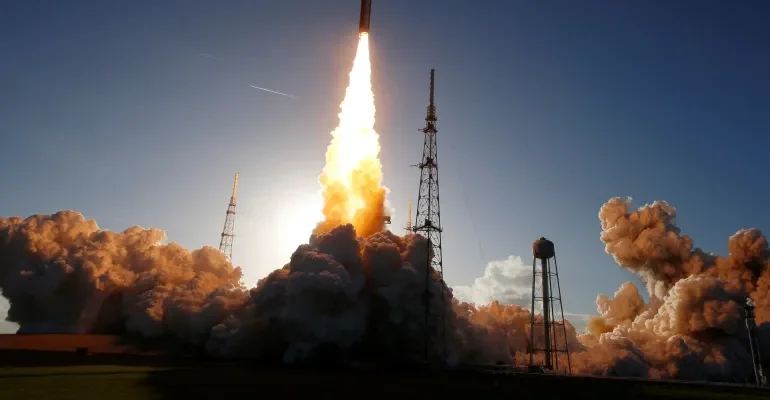
The National Aeronautics and Space Administration (NASA) has launched the Artemis II space mission from Florida, sending four astronauts on a historic journey around the moon and marking the first time humans have travelled beyond low-Earth orbit in more than 50 years.
The mission, which blasted off on Wednesday, represents a major milestone in NASA’s ambitious plan to return humans to the moon and eventually send astronauts to Mars.
Thousands of spectators gathered along Florida’s coast to witness the historic liftoff.
The Artemis II crew comprises NASA astronauts Reid Wiseman, Victor Glover and Christina Koch, alongside Canadian Space Agency astronaut Jeremy Hansen.
The four are expected to undertake a nearly 10-day journey around the moon and back, travelling farther into space than any human crew in decades.
“On this historic mission, you take with you the heart of this Artemis team, the daring spirit of the American people and our partners across the globe, and the hopes and dreams of a new generation. Good luck, Godspeed Artemis II. Let’s go,” said launch director Charlie Blackwell‑Thompson.
Five minutes into the flight, mission commander Wiseman reported the crew’s first sighting of their destination.
“We have a beautiful moonrise, we’re headed right at it,” he said from the capsule.
The launch followed months of technical preparations and delays, including concerns over hydrogen leaks detected during earlier testing.
However, NASA confirmed that no significant hydrogen leaks were detected during final fueling operations, allowing engineers to successfully load more than 700,000 gallons (2.6 million litres) of fuel into the Space Launch System rocket.
According to Al Jazeera, engineers also resolved several technical issues ahead of liftoff, including problems with commands to the rocket’s flight-termination system, designed to trigger a self-destruct signal if the rocket veers off course.
Another concern involving temperature readings in a battery within the Orion capsule launch-abort system was also addressed before launch.
Once in orbit, the crew began extensive system checks, including testing Orion’s life-support, propulsion, navigation and communications systems to ensure the spacecraft is ready for deep space operations.
Following these checks, Orion will perform a critical manoeuvre known as translunar injection, sending the spacecraft out of Earth’s orbit and onto a trajectory toward the moon.
The journey will take several days, with the astronauts continuing to monitor spacecraft systems as they travel farther from Earth.
The spacecraft will then fly behind the moon on a free-return trajectory, allowing the gravitational pull of both the moon and Earth to naturally guide Orion back home while using minimal fuel.
During this phase, the spacecraft will reach its farthest distance from Earth.
After the lunar flyby, the crew will spend several days returning to Earth while conducting additional deep-space tests, including power systems, thermal controls and crew operations.
As Orion approaches Earth, it will re-enter the atmosphere at speeds of about 40,233 kilometres per hour before splashing down in the Pacific Ocean, where recovery teams will retrieve the crew.
With more than half of the world’s population not yet born when the Apollo programme last sent astronauts to the moon, Artemis is being positioned as a mission for a new generation.
“There are a lot of people who don’t remember Apollo. There are generations who weren’t alive when Apollo launched. This is their Apollo,” NASA science mission chief, Nicky Fox, said earlier this week.
The Artemis II mission marks a critical step toward future lunar landings and long-term plans to send humans deeper into space, including the first crewed mission to Mars.
WARNING! All rights reserved. This material, and other digital content on this website, may not be reproduced, published, broadcast, rewritten or redistributed in whole or in part without prior express permission from ZAMBIA MONITOR.












Comments