
 By
By 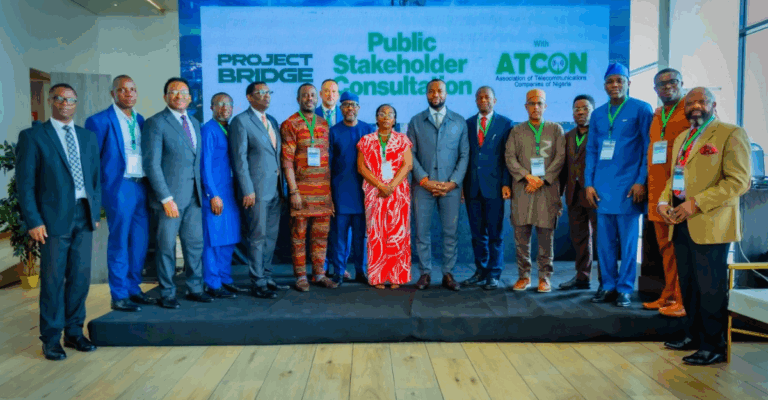
Nigeria’s Minister of Communications, Innovation and Digital Economy, Bosun Tijani, has unveiled the high-level technical design for Project Bridge, describing it as the most ambitious digital infrastructure initiative in the nation’s history — and the largest fibre backbone investment ever undertaken in a developing country.
The flagship project, a key component of President Bola Ahmed Tinubu’s Renewed Hope Agenda, will deliver a 90,000-kilometre wholesale, open-access fibre network across the country.
TechAfrica reports that when combined with Nigeria’s existing 35,000km of fibre, it would create a 125,000km national backbone aimed at providing high-speed, resilient and equitable broadband connectivity to all Nigerians — from major cities to the most remote rural communities.
Speaking at a stakeholder event in Lagos, hosted in partnership with the Association of Telecom Operators of Nigeria (ATCON), Tijani said the design represents a major step towards building a truly inclusive and future-ready digital economy.
Project Bridge will feature a scalable architecture spanning core, metropolitan, and middle-mile layers, enabling both large and small Internet Service Providers to expand coverage.
By promoting competition and infrastructure sharing, it seeks to close Nigeria’s connectivity gap and accelerate broadband access nationwide.
Central to the design are seven regional backbone rings covering Nigeria’s six geopolitical zones — Lagos, South West, South South, South East, North Central, North East, and North West.
These interconnected rings will ensure redundancy, reduce latency, and guarantee seamless nationwide data flow. The plan also includes 37 metropolitan networks and fibre links to all 774 Local Government Areas (LGAs).
From each LGA, a Point of Presence (PoP) will serve as a hub to extend fibre to administrative wards, with a focus on schools and healthcare facilities.
These ward-level nodes will support last-mile distribution to underserved communities.
The final phase will connect homes, businesses and institutions via fibre or alternative access technologies, leveraging the middle-mile network for reliable service delivery.
Dr. Tijani urged stakeholders to share feedback on the rollout process, saying:
“This marks a major step forward in our mission to build a truly inclusive and future-ready digital economy for all Nigerians.”
WARNING! All rights reserved. This material, and other digital content on this website, may not be reproduced, published, broadcast, rewritten or redistributed in whole or in part without prior express permission from ZAMBIA MONITOR.











Comments