
 By
By 
The 2025 Information Communications and Technology (ICT) and Postal Sector Market Performance Report has highlighted a continued strong growth trajectory and notable positive developments across various market segments.
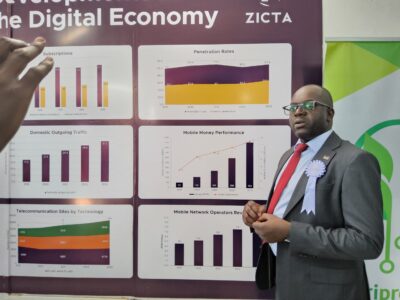
Mobile cellular subscriptions grew by 13.1 percent, rising from 23.2 million in 2024 to 26.2 million in 2025, according to the report released on Friday by the Zambia Information and Communications Technology Authority.
ZICTA Manager for Corporate Communications, Hanford Chaaba, said the report showed that internet subscriptions increased by 10.1 percent—from 13.3 million to 14.7 million—reflecting a growing demand for broadband services across the country.
ZICTA noted that the growth was supported by continued investment in telecommunications infrastructure, increased use of digital platforms in economic and social activities, and improvements in the affordability of ICT services driven by promotional offers and more tailored service packages.
In line with the rise in subscriptions, total domestic outgoing voice traffic increased by 3.6 percent, from 34.7 billion minutes in 2024 to 36 billion minutes in 2025.
Mobile network bandwidth capacity increased from 1.18 exabytes to 1.23 exabytes, while utilisation rose from 66.8 percent to 67.5 percent, indicating growing demand for mobile data services.
The number of telecommunications towers increased from 3,551 in 2024 to 3,751 in 2025, while total telecommunications sites rose from 14,519 to 14,909—largely driven by the rollout of 5G infrastructure.
“These developments contributed to the improved performance, with revenues in the mobile network operator (MNO) subsector increasing by 13.9 percent, from K11.54 billion in 2024 to K13.15 billion in 2025,” the report said.
The report, however, noted that international voice traffic continued to decline due to the growing use of alternative communication platforms such as over-the-top (OTT) applications.
During the review period, regulatory and policy advancements were also recorded aimed at strengthening market competitiveness, consumer protection, and digital transformation.
These included the revision of Consumer Protection Guidelines, the introduction of a new ICT Licensing Framework to simplify licensing and support innovation, and the launch of the National Child Online Protection Strategy (2025–2029).
Other developments included the transition from physical recharge vouchers to digital platforms, development of E-Band and Satellite Licensing Guidelines, and the enactment of the Cybersecurity Act, which paved the way for establishing a national cybersecurity agency.
Chaaba added that continued growth in demand for digital services, expansion of mobile network coverage, and increasing availability of digital public services and e-commerce platforms were expected to further propel sector growth.
“Mobile subscriptions are projected to reach 27.8 million by the end of 2026, representing a penetration rate of approximately 131.3 percent,” he said.
Chaaba noted that the broader business environment was expected to keep improving, supported by positive macroeconomic fundamentals such as lower inflation and a strengthening local currency.
He added that improvements in electricity supply and increased investments in alternative energy solutions for telecommunications infrastructure were expected to reduce operational costs for service providers and enhance service quality.
“Network coverage is also set to expand significantly with the anticipated construction of over 300 telecommunications towers under the World Bank-supported Digital Zambia Acceleration Project (DZAP), alongside additional infrastructure investments by operators to meet regulatory Quality of Service (QoS) requirements,” Chaaba said.
He, however, cautioned that as digital adoption rose, online risks and cybersecurity threats remained a major challenge, underscoring the need for sustained consumer awareness and strengthened cybersecurity interventions.
WARNING! All rights reserved. This material, and other digital content on this website, may not be reproduced, published, broadcast, rewritten or redistributed in whole or in part without prior express permission from ZAMBIA MONITOR.











Comments