
 By
By 
Cabinet has authorised the Minister of Finance and National Planning to seek a 12-month extension of the International Monetary Fund (IMF) Extended Credit Facility (ECF)-supported programme.
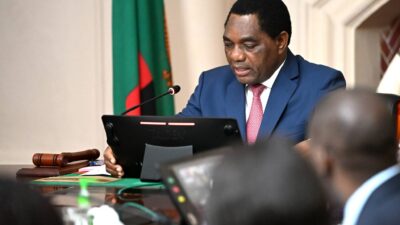
The decision was made during the 14th Cabinet Meeting of 2025, held on Monday, July 28, at State House and chaired by President Hakainde Hichilema.
The meeting focused on key policy and legislative matters.
Chief Government Spokesperson, Cornelius Mweetwa, told journalists during a media briefing in Lusaka on Wednesday that the extension aims to consolidate progress made during the programme’s implementation and support Zambia’s ongoing homegrown economic reform agenda.
He explained that the ECF programme, initially scheduled to end on October 31, 2025, would, if approved by the IMF Executive Board, run until October 31, 2026.
Mweetwa noted that the 38-month programme was originally approved in August 2022, with financial support amounting to US$1.3 billion. It was designed to restore macroeconomic stability, strengthen investor confidence, and promote inclusive and resilient growth.
He said the programme targeted key macroeconomic challenges, including Zambia’s high debt burden and weak governance structures.
Following the 2023/2024 farming season, which was severely affected by drought, the IMF augmented financial support under the programme to US$1.7 billion.
“In approving the request for an extension, Cabinet reaffirmed its commitment to the homegrown economic reform agenda, which underpins the programme,” Mweetwa said.
He added: “The proposed extension is a clear demonstration of Government’s resolve to sustain critical reforms, maintain investor confidence, and mobilise additional external resources for Zambia, including development financing.”
Mweetwa also revealed that Cabinet acknowledged the burden of domestic debt inherited by the New Dawn Administration, citing unsustainable borrowing practices in previous years.
He noted that Zambia’s domestic debt stock surged by 681.3 percent—rising from K24.70 billion in 2015 to K192.99 billion in 2021. Over the same period, the debt service-to-revenue ratio grew from 11 percent in 2011 to nearly 59 percent in 2021.
“To put it into perspective, for every K100 collected in revenue in 2021, K59 went to debt servicing, compared to only K11 in 2011,” he said.
Mweetwa explained that had the previous administration fully serviced its debt obligations, the remaining revenue would have been insufficient to cover public sector wages, which stood at 45 percent of total revenue. The resulting fiscal strain led Zambia to default on its external debt in November 2020.
“In response, the New Dawn Administration enacted the Public Debt Management Act of 2022 to prevent recurrence of such distress,” he stated.
The Act transfers borrowing authority from the Executive to Parliament through the Annual Borrowing Plan and mandates annual Debt Sustainability Analyses to ensure responsible, transparent debt acquisition.
“The extension of the ECF programme will support continued macroeconomic stability, finalisation of the debt restructuring process, and enhancement of investor confidence,” Mweetwa said.
Meanwhile, Cabinet also approved the issuance of the Road Traffic (Public Service Vehicles) (Global Positioning System) (Amendment) Regulations, 2025.
According to Mweetwa, the new regulations are aimed at reducing road traffic accidents by improving driver behaviour among public service vehicles, including buses and freight trucks.
“The GPS mandate will promote road safety through real-time monitoring and accountability mechanisms for public transport,” he said.
WARNING! All rights reserved. This material, and other digital content on this website, may not be reproduced, published, broadcast, rewritten or redistributed in whole or in part without prior express permission from ZAMBIA MONITOR.











Comments