
 By
By 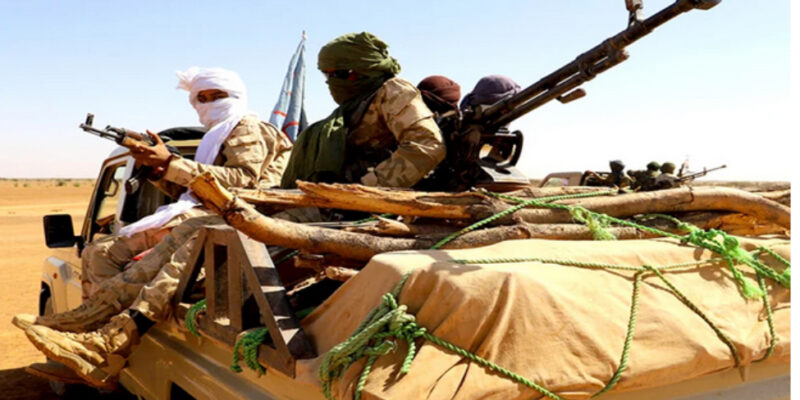
Since April 25, 2026, jihadists from Jama’at Nusrat al-Islam wal-Muslimin (JNIM) and Tuareg rebels from the Azawad Liberation Front have been conducting coordinated attacks against Mali. These military operations aim to destabilize the government and cannot be interpreted as an internal Malian crisis.
The worsening security, political, and economic situation in Mali is due to several factors that reveal Algeria’s involvement, given its historical and political ties with certain Tuareg movements, its stance regarding the current offensive by rebel and terrorist groups, and its attitude toward the dynamics of opposition to the Malian regime.
Algeria’s support for the Tuareg rebellion has significantly contributed to the destabilization of Mali. Indeed, this relationship has contributed to weakening the authority of the Malian state over part of its territory and to maintaining a separatist dynamic.
Read more: Mali officially supports Morocco’s autonomy plan as only solution for Moroccan Sahara
The link between armed rebellion and terrorist movements, particularly JNIM, represents another important element explaining the current situation in Mali and poses a direct threat to the stability of the entire Sahel region.
In addition to these two significant factors, the country’s opposition, embodied by influential religious and political figures, notably Mahmoud Dicko, has further weakened the current Malian authorities by presenting itself as a political alternative. Finally, the blockade imposed by JNIM against the Malian state has significantly contributed to weakening the national economy and increasing political pressure on Bamako.
All these factors have contributed to Mali entering a phase of destabilization that could transform the country into a vast hotbed of tension in the heart of the Sahel, harboring terrorist groups from Africa, the Middle East, and other conflict zones. This situation would pave the way for armed groups to establish safe havens, potentially using Malian territory as a rear base to plan, recruit, finance, and launch their operations.
Consequently, a destabilized Mali would have immediate repercussions for Niger and Burkina Faso, two countries already under intense terrorist pressure. Togo, Benin, Ivory Coast, Senegal, Guinea, and Mauritania could also suffer the security consequences of a Mali weakened by terrorist groups. The evolution of the Malian crisis would lead to a dangerous security reconfiguration in West Africa, with a risk of violence spreading to coastal and Atlantic areas.
Regarding the impact of the Malian crisis on the Maghreb and the Mediterranean, an unstable Mali would have direct consequences for the Maghreb, particularly for networks involved in irregular migration, arms trafficking, drug trafficking, and transnational organized crime. The stability of Mali is thus an essential condition for the stability of the Sahel, West Africa, the Maghreb, and the Mediterranean.
In response to this unstable situation in the Sahel, the regional and international community has an obligation to support Mali’s territorial integrity and to stand firm against terrorist or separatist groups operating in Mali in order to prevent the country from becoming a lasting source of destabilization. The Malian crisis now transcends national borders. It constitutes a major test for collective security in West Africa, the Sahel, the Maghreb, and the Mediterranean.
WARNING! All rights reserved. This material, and other digital content on this website, may not be reproduced, published, broadcast, rewritten or redistributed in whole or in part without prior express permission from ZAMBIA MONITOR.








Comments