
 By
By 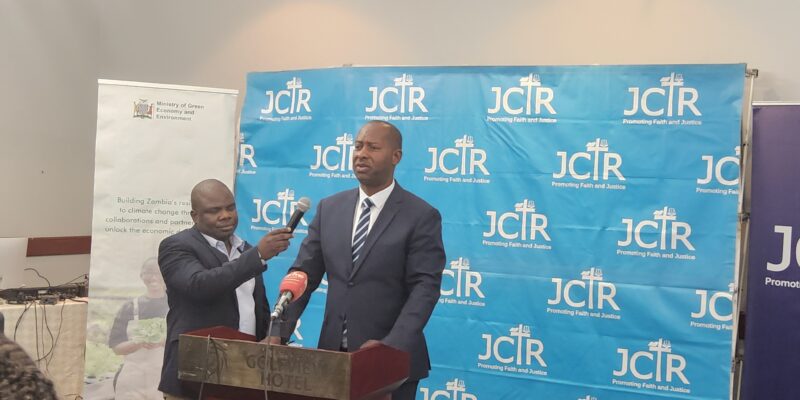
The Zambian government has announced that it was taking over the procurement process for an independent consulting firm to assess the extent of Kafue River pollution caused by Sino Leach Metal Zambia in Chambeshi District, Copperbelt Province.
A dam failure at Sino Leach Metal Zambia resulted in the release of approximately 50,000 cubic meters of acidic slurry containing heavy metals into nearby water bodies, raising serious environmental and public health concerns.
Green Economy and Environment Minister, Mike Mposha, made the announcement during the National Summit on Climate Change Adaptation and Environment in Lusaka on Tuesday, held at the Golf View Hotel in collaboration with the Jesuit Centre for Theological Reflections (JCTR).
Mposha said the consultant will provide a comprehensive report on the presence and concentration of heavy metals in the environment and water systems.
He noted that 14 consulting firms had expressed interest in the role, and that shortlisting and vetting had already been completed.
“We are working on procuring an independent consultant who will conduct an assessment to provide a report on the extent of the pollution and the types of heavy metals in the environment and water bodies,” Mposha stated.
The Minister explained that initial efforts to assess the damage were delayed by a dispute between Sino Leach Metals Zambia and a consultant it had hired, which led to the termination of the contract in May.
“The termination of the contract for the previous consultant by the Chinese firm caused further delays, prompting the government to take over the process,” Mposha said.
He added that full compensation for affected families will be made once the consultant completes the assessment, though Sino Leach Metal Zambia had provided an initial compensation.
To expedite the matter, the Ministry, he said, engaged the Zambia Public Procurement Authority (ZPPA) to shorten the procurement process due to the urgency of the issue.
Mposha noted that the call for expressions of interest ran for one week in July 2025, and that the government was now moving forward with the final stage of procurement.
“We invoked Section 107 of the Environmental Management Act, which allows the government to take over the process when there is a dispute. This ensures that a comprehensive assessment is conducted,” he said.
Mposha warned that Zambia would not spare any investor who violated environmental laws and stressed that the Ministry remained open to dialogue with churches and civil society organizations wishing to offer advice or support on the matter.
Read More: Government seeks legal guidance on Kafue River pollution by Sino Leach Metals
He also reiterated that the pH levels of water currently supplied in Kitwe by Nkana Water and Sanitation Company were within World Health Organization (WHO) standards.
On August 26, Minister Mposha announced that water samples from Ndola, Luanshya, Masaiti, Mpongwe, Kitwe, Kalulushi, Chambishi, Mufulira, Chililabombwe, and Chingola indicated pH levels had returned to normal ranges and concentrations of heavy metals such as cadmium, cobalt, copper, manganese, and zinc were declining.
“These findings suggest our water resources are beginning to recover from the pollution incident, possibly due to natural processes involving physical, chemical, and biological factors,” he said.
However, Mposha noted that a full assessment was needed to confirm these improvements across all affected sites and ensure long-term environmental safety.
WARNING! All rights reserved. This material, and other digital content on this website, may not be reproduced, published, broadcast, rewritten or redistributed in whole or in part without prior express permission from ZAMBIA MONITOR.







Comments