
 By
By 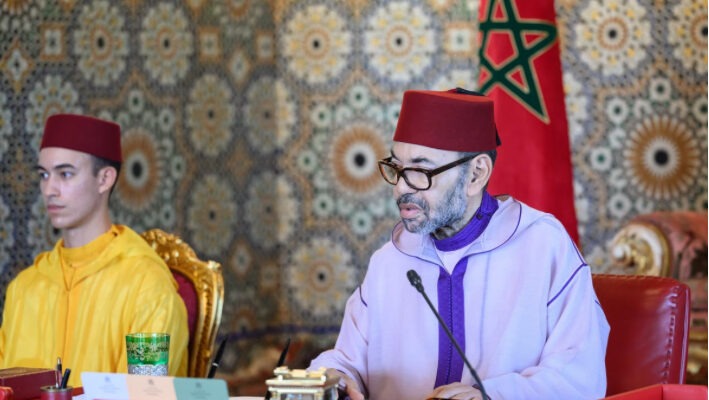
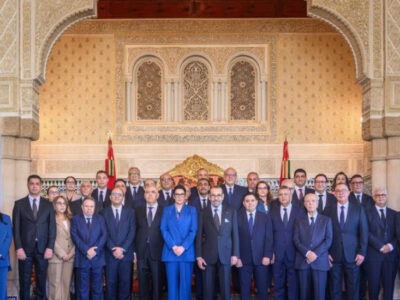
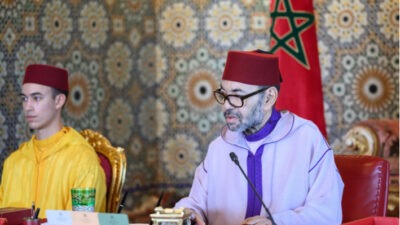
His Majesty the King of Morocco Mohammed VI accompanied by His Royal Highness the Crown Prince Moulay El Hassan, presided, this Saturday, October 17, 2026 at the Royal Palace in Rabat, a Council of Ministers dedicated to the examination and adoption of the general guidelines of the Draft Finance Law for the year 2027.
At the beginning of the work of the Council, and in accordance with the provisions of Article 49 of the Constitution, the Minister of Economy, Finance and Public Performance presented to His Majesty the King a presentation on the outlines of the Draft Finance Law of the year 2027.
The minister stressed that this project is taking place in a deeply unstable international environment, marked by the increase in the cost of geostrategic conflicts, the rise of protectionist tendencies and the exacerbation of competition around energy, technology and financing.
Faced with these changes, our country continues, under the enlightened Conduct of His Majesty the King the consolidation of the foundations of his resilience and the strengthening of the dynamism of his economy. Thus, the national economy is expected to grow by 4.7% at the end of the current year, with inflation contained at 0.7%, along with a reduction in the budget deficit that is expected to be reduced to 3% of GDP.
Read more: Morocco : King Mohammed VI appoints a new government
The 2027 Budget Year Finance Bill focuses on the following five priorities:
First: Restoration of purchasing power and consolidation of the foundations of a sustainable social state: In this context, a structural reform of markets and prices will be undertaken, from the year 2027, and accompanied by measures to support the purchasing power of citizens, to continue the generalization of medical coverage, while ensuring the sustainability of its schemes, the revaluation of direct social assistance,
Second: Integration of young people into education, training and decent employment: The government will work to launch an integrated national program for young people 2027-2031, based on their orientation towards a set of programs focused on training, incubation and facilitating access to finance, guarantee mechanisms and markets.
Third: Acceleration of the implementation of advanced regionalization and the new generation of integrated territorial development programmes: in accordance with the High Royal Guidelines concerning the reorganization of regional competences, based on an approach of clarity and efficiency, as well as on the consolidation of coordination and contractualization mechanisms between the State and the regions, in parallel with the full implementation of the National Charter of Administrative Deconcentration.
Fourth: Strengthening strategic water, energy, food and digital sovereignty: in order to ensure strategic water security, accelerate the renewable energy development program and continue the deployment of the Morocco supply for green hydrogen, as well as the gradual implementation of the gas infrastructure roadmap, in parallel with a series of measures to guarantee food security and strengthen national digital sovereignty.
Fifth: Building a strong economy, capable of financing social and sovereign ambition, in parallel with the acceleration of the implementation of institutional reforms and the preservation of macroeconomic and budgetary balances: and this, with the aim of mobilizing the necessary financing to accelerate the dynamics of projects, major development projects and sectoral strategies engaged in the various fields, in parallel with the development of new sovereign industrial ecosystems.
The draft Finance Act for the year 2027 also pays particular attention to the strengthening of private investment, through the consolidation of the support mechanisms provided for in the Investment Charter and the continuation of the reform of the Regional Investment Centres, while focusing on support for very small, small and medium-sized enterprises.
The Finance Bill of the Year 2027 also attaches particular importance to the issue of young people, which is one of the most important and urgent issues of this phase, which requires overcoming the multiplicity of dispersed sectoral programs that have shown their limits, in favor of an integrated national policy for the monitoring of the journeys of young people, from education and training to employment and housing, guaranteeing them a social stability.
And in application of the High Royal Orientations, the implementation of the new generation of integrated territorial development programs will be accelerated, mobilizing budgetary appropriations of the order of 25 billion dirhams.
WARNING! All rights reserved. This material, and other digital content on this website, may not be reproduced, published, broadcast, rewritten or redistributed in whole or in part without prior express permission from ZAMBIA MONITOR.





Comments