
 By
By 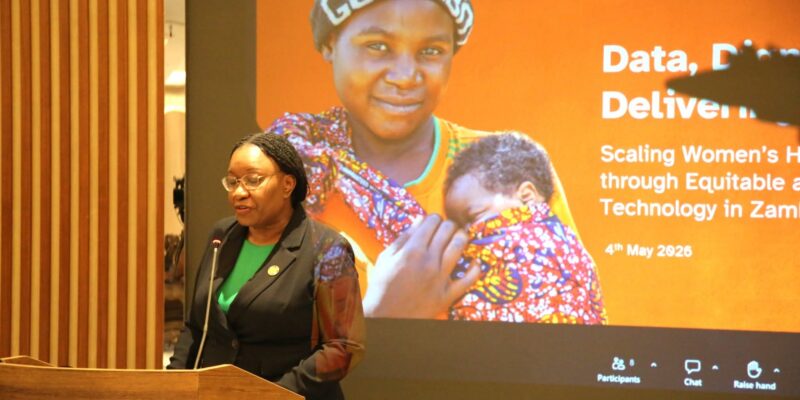
The United Nations Population Fund (UNFPA) has urged governments and partners to recognise technology in women’s health as a human right, warning that Zambia continues to face high maternal mortality despite medical advances.
UNFPA Regional Director for East and Southern Africa, Lydia Zigomo, said digital innovation was transforming global health systems but many women remained excluded due to inequality, weak systems and limited access.
Speaking in Lusaka on Monday at the session titled “Data, Dignity and Delivering Impact: Scaling Women’s Health Innovation through Equitable and Ethical Technology in Zambia” held at Sarovar Hotel, Zigomo said the meeting aimed to explore how technology and data could advance dignity and save lives.
“Today, we are not here to talk about technology as a luxury. We are here to talk about technology as a human right,” she said.
Zigomo noted that globally, around 700 women die every day from preventable pregnancy and childbirth-related causes, while 20 to 30 more suffer long-term injuries or complications.
“These are not failures of science. They are failures of access, of equity and of systems,” she said.
Zambia has recorded improvements in maternal health, but maternal mortality remains above the global target of fewer than 70 deaths per 100,000 live births. Current national estimates range between 135 and 187 deaths per 100,000 live births.
Read More: Use data for decision-making, not shelf storage – UNFPA tells Zambian government
Zigomo said Zambia was demonstrating regional leadership through its National Artificial Intelligence Strategy 2024–2026, which focuses on expanding digital connectivity, improving data reliability and strengthening precision public health.
However, she cautioned that technology was “scaling faster than trust,” with women and girls disproportionately exposed to risks associated with sensitive personal data.
“Information about a woman’s body — her pregnancy, her reproductive health, her choices — is among the most personal data that exists,” she said.
Zigomo highlighted UNFPA’s WomenX Collective initiative, which is supporting the national scale-up of Point-of-Care Ultrasound.
The programme aims to equip midwives and frontline health workers with portable ultrasound devices to detect complications earlier, improve referral pathways and strengthen continuity of care.
She said the goal was to ensure innovations move beyond pilot phases and integrate fully into health systems to benefit all women.
WARNING! All rights reserved. This material, and other digital content on this website, may not be reproduced, published, broadcast, rewritten or redistributed in whole or in part without prior express permission from ZAMBIA MONITOR.











Comments