
 By
By 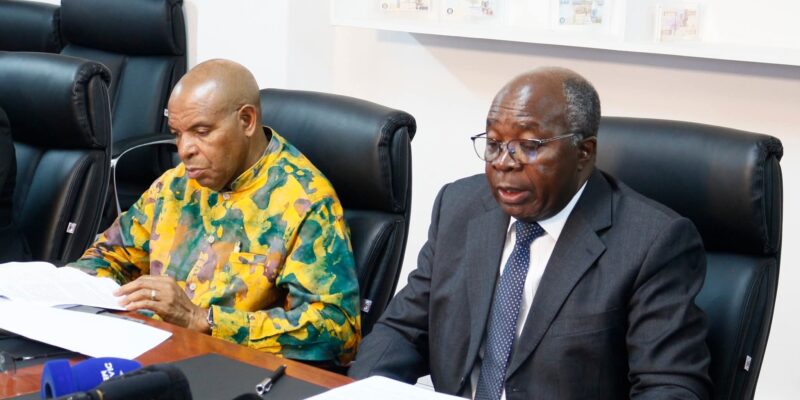
The Zambian government has announced that it will not pursue a one-year extension of its current International Monetary Fund (IMF) Extended Credit Facility (ECF) program.
Instead, officials would move directly to a full successor arrangement that would run the complete course, reflecting a deliberate shift toward a growth-focused economic agenda.
The government had initially sought a 12-month extension and in September won a three-month window to negotiate, hoping to secure an additional US$145 million.
The IMF confirmed that with Zambia’s withdrawal from the extension, discussions on prolonging the arrangement have ended, though the board will still consider the sixth and final review of the program, which could release around US$190 million.
Speaking at a media briefing in Lusaka on Thursday, Finance and National Planning Minister, Situmbeko Musokotwane, said the government had successfully completed all reviews under the current ECF program, which started in 2022 and was originally scheduled to conclude in November 2025.
“The programme will now hopefully be concluded by mid-January 2026,” he noted, clarifying that the slight extension is technical and intended to allow adequate time for assessing programme performance.
Read more: IMF deal signals strong reform progress, boosts investor confidence —Musokotwane
The decision to forgo a one-year extension is said to reflect Zambia’s strong track record under the IMF-supported program.
Since 2022, reports note that the country has consistently met all quantitative performance criteria and structural benchmarks, achieving primary fiscal surpluses exceeding two percent of GDP, stabilizing public finances, and strengthening debt sustainability.
The reforms are said to have restored macroeconomic confidence, improved fiscal and external buffers, and positioned the country to benefit from favourable copper prices through a revitalized mining sector.
“The policy priority is not to pursue a one-year extension of the current ECF programme but to deliberately transition towards a growth-focused agenda that accelerates investment, supports job creation, and expands the productive capacity of the Zambian economy,” Musokotwane said.
The successor program with the IMF would address Zambia’s ongoing debt restructuring commitments while also tackling broader economic priorities, including medium-term development needs, structural reforms, and investment mobilization.
Musokotwane emphasized that this transition did not signal disengagement from reform but rather built on the solid foundations achieved under the current ECF arrangement.
During the transition period, he said, Zambia would maintain strict adherence to its national budget and continue close engagement with the IMF, including through Article IV consultations and technical dialogue.
Musokotwane reaffirmed the government’s commitment to fiscal discipline, prudent resource management, and inclusive economic growth that creates jobs and diversifies the economy.
“The reforms we have undertaken—and those yet to be undertaken—reflect national ownership and are not contingent on any single external arrangement,” he added, highlighting that the country is already seeing tangible benefits in economic stability, infrastructure expansion, education, foreign exchange reserves, and investment.
WARNING! All rights reserved. This material, and other digital content on this website, may not be reproduced, published, broadcast, rewritten or redistributed in whole or in part without prior express permission from ZAMBIA MONITOR.











Comments