
 By
By 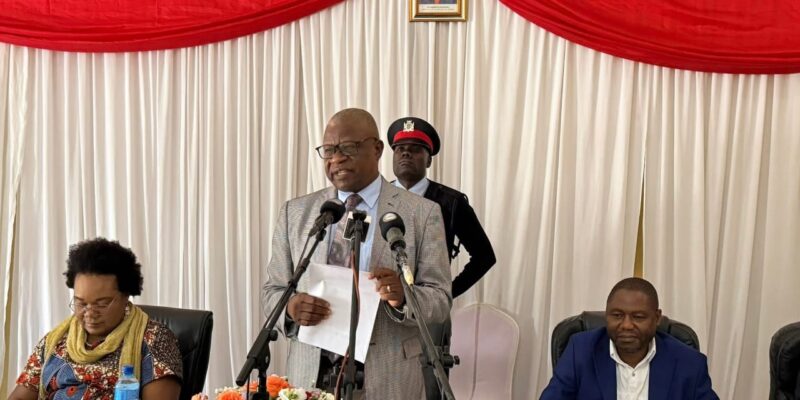
The Ministry of Mines and Minerals Development has reiterated its commitment to cancelling mining licences held for speculative purposes or those failing to meet regulatory requirements.
Permanent Secretary, Hapenga Kabeta, said the government would not tolerate the misuse of mining licences, describing them as national assets that must deliver tangible benefits to citizens.
In an interview in Solwexi on Wednesday last week, Kabeta stressed that licences were issued with the expectation that they would contribute to national development through increased revenue and improved public services.
“Licences are not for speculation. We shall continue to cancel those that are not being utilised as intended,” he said.
He explained that communities across the country anticipated positive outcomes whenever a mining licence was granted, including enhanced access to services such as education.
“When a licence is issued, even a child in Kaputa, Rufunsa, Mbala or Shangombo expects that it will translate into benefits like free education. These licences belong to the nation,” Kabeta said.
He warned that individuals or companies that failed to develop their licences or comply with set regulations risked losing them.
Those found wanting were first issued with default notices and given a 30-day period to rectify any breaches.
Failure to comply within the stipulated time may result in licence cancellation.
Kabeta also highlighted the creation of the Mineral Regulation Commission, which was expected to enhance oversight and enforcement in the mining sector.
Meanwhile, the Federation of Small Scale Mining Associations of Zambia (FSSMAZ) has expressed concern over what it describes as disparities in Environmental Impact Assessment (EIA) fees following recent adjustments by the Zambia Environmental Management Agency (ZEMA).
In a statement issued on Monday, the association noted that while Statutory Instrument No. 3 of 2026 introduced reduced EIA fees for certain categories of miners, the benefits largely favour those classified under Class V, excluding artisanal gemstone miners.
Under the revised structure, activities such as artisanal processing of base metals including copper, zinc and lead, as well as small-scale quarrying and exploration, now attract reduced fees of approximately K5, 333.
However, FSSMAZ said artisanal gemstone mining has been placed under Class III, where review fees have risen significantly to about K106, 666 from K17, 000, representing an increase of 527 percent.
Read more: Small-scale miners call for national strategy, propose $3 million equipment loan scheme
The association further highlighted disparities affecting small-scale miners operating within licence areas of four to 10 square kilometres.
While those engaged in base and energy minerals under Class IV are charged about K53,333, gemstone miners in the same category are required to pay as much as K600,000.
FSSMAZ described the differences as excessive, arguing that gemstone miners were subjected to significantly higher costs despite operating under similar artisanal licences and facing comparable financial constraints.
The association further argued that EIA classification should be based on the nature of the mining licence rather than the mineral being extracted, stating that licences already define operational scale and environmental risk.
“It is unjustifiable that miners operating under the same licence regime, with similar operational footprints and environmental risk profiles, are subjected to fees that are ten to twenty times higher simply because of the mineral they extract,” the statement read.
FSSMAZ has since called on ZEMA to review the classification framework and include gemstone mining under Class V alongside other artisanal activities.
It has also urged the Ministry of Green Economy and Environment to engage the Ministry of Mines and Minerals Development to harmonise EIA classifications with the existing mining licence system.
WARNING! All rights reserved. This material, and other digital content on this website, may not be reproduced, published, broadcast, rewritten or redistributed in whole or in part without prior express permission from ZAMBIA MONITOR.







Comments