
 By
By 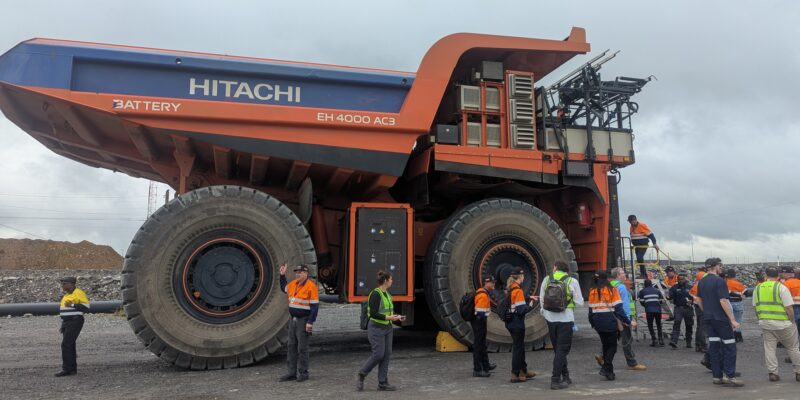
Zambia has taken a major step toward green mining following the launch of the first-ever battery electric vehicle (BEV) mining truck showcase by First Quantum Minerals (FQM) in partnership with Hitachi Construction Machinery.
The development is said to reinforce Zambia’s growing reputation as a hub for mining innovation driven by strong partnerships between government, industry and technology providers.
Speaking during the launch in Solwezi on Wednesday, Ministry of Mines and Minerals Development Permanent Secretary, Hapenga Kabeta, described the initiative as a significant milestone aligned with government’s agenda to promote clean energy and sustainable mining practices.
Kabeta said the partnership demonstrated Zambia’s commitment to reducing reliance on fossil fuels while advancing environmental sustainability in the mining sector.
“The launch of this partnership today is very important to the government agenda of Zambia. The use of clean energy over fossil fuels is the way to go. Environmental sustainability is important to save the planet from rising levels of climate change,” he said.
He noted that the collaboration reflected responsible mining practices and strong corporate citizenship, adding that FQM continues to prioritise local participation, with approximately 96 percent of its workforce made up of Zambian citizens, including representation at senior management level.
Kabeta added that government was proud of the investment, stating that technological advancement in mining would lower production costs and enhance Zambia’s competitiveness as a global mining destination.
“As government, this partnership is one which we are very proud of, as it puts Zambia on the map as a leading mining destination where technology is at the frontline of success,” he said.
Meanwhile, Tristan Pascall, Chief Executive Officer of First Quantum Minerals, said the battery electric mining truck represented years of research, development and collaboration between industry, government and technology partners.
Pascall said the innovation placed Zambia at the forefront of global mining technology, noting that the project was the first of its kind.
“This really is the first of its kind. Zambia is right at the forefront of that and can export that understanding to the world in terms of the technology at play,” he said.
He explained that fleet electrification had the potential to significantly reduce greenhouse gas emissions while also protecting mining operations from global fuel price volatility.
Pascall also acknowledged government support, particularly from the Mine Safety Department, for facilitating permits that enabled safe testing of the technology.
He further highlighted the long-standing partnership between FQM and Hitachi, which dates back to 2012, noting that collaboration had evolved from trolley assist systems to battery electric mining technology.
“Mining doesn’t move forward without strong suppliers and technology partners. Hitachi has been an important partner to First Quantum for many years, and today’s achievement is a function of that history,” he said.
Speaking at the same event, Ray Kitic, Vice President for Mining Business at Hitachi Construction Machinery, said the showcase demonstrated the strength of collaboration and Zambia’s suitability for decarbonisation initiatives.
Kitic said Zambia’s energy mix, dominated by hydroelectric power, made it an ideal environment for testing low-emission mining technology.
“To be here in Zambia where 85 percent of electricity is generated through hydro, there could not be a better place to validate true decarbonisation,” he said.
He added that the project was guided by key principles including safety, practicality, durability and commercial viability, noting that decarbonisation efforts must also make economic sense.
Kitic further acknowledged the collaboration between Hitachi, First Quantum Minerals and partners such as ABB, describing the initiative as a major step toward sustainable mining.
WARNING! All rights reserved. This material, and other digital content on this website, may not be reproduced, published, broadcast, rewritten or redistributed in whole or in part without prior express permission from ZAMBIA MONITOR.





Comments