
 By
By 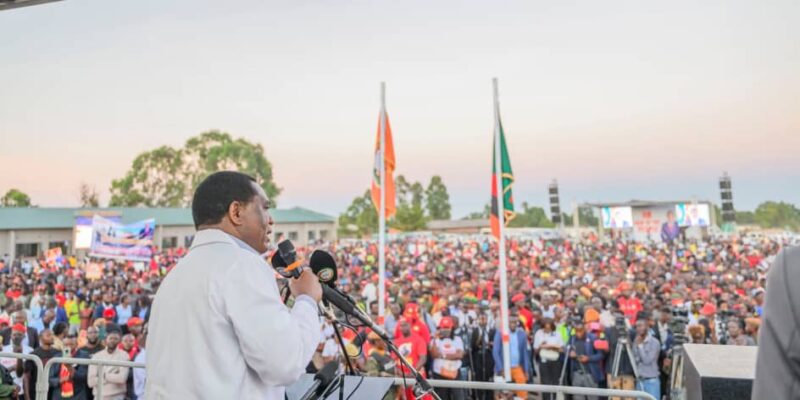
President Hakainde Hichilema on Friday called for industrial harmony between employers and workers, saying labour disputes should be resolved through dialogue rather than street protests.
Addressing Labour Day commemorations in Chinsali, the president said cooperation between labour and capital was vital for business growth and job creation, especially as the government had provided free education to young people.
He noted that the government acted both as a policy maker and a major employer in the labour sector.
“Dialogue is at the dialogue table. You may want to do street fights but you will end up sitting down together to resolve that which you were doing in the streets at the dialogue table,” he said.
Hichilema stressed that industrial harmony was essential for economic expansion, arguing that disruptions undermined production and investment.
“If Madam Ngoma you are unhappy with the workers, engage the labour leaders. If workers are calm, we expect employers not to wait until workers are rioters. They must address workers’ concerns. If workers have grievances, engage the employers,” he said.
During the event, Hichilema directed Minister of Infrastructure Development Charles Milupi to expedite remedial works on the Mkushi–Serenje–Mpika–Chinsali–Nakonde Road, warning that the route had become a “death trap.”
He said the poor state of the road was stifling economic activity in Northern Province, Muchinga Province and surrounding regions.
“My message back to Lusaka is to the Minister of Infrastructure to expedite the remedial works on this road,” he said. “We cannot talk of an economy in Muchinga, in Northern, if this road is not fixed,” he said.
Hichilema also cited the Chipata–Lundazi–Chama Road as a priority, saying production and trade in Eastern province depended on it.
The president urged residents of Muchinga to set up large-scale commercial farms, saying the province’s fertile soils and abundant water made it ideal for high-volume food production.
“We want to see big farms here run by the children of Muchinga. Utilise the water that God gave us here,” he said.
He encouraged “local boys and girls… local men and women” to move into commercial agriculture, arguing the province must shift from subsistence to large-scale production.
Increased output, he said, would reduce reliance on imports and underpin economic growth in Northern, Muchinga and Eastern provinces.
Zambia Congress of Trade Unions president. Blake Mulala, called for expanded TEVET funding, improved workplace apprenticeships, digital literacy initiatives, retraining for displaced workers and stronger university-industry linkages.
“When a mine modernises, Zambian workers must be promoted and not replaced because they have limited skills set. Our call Mr. President is that when industries grow, local skills must grow with them. We further call on your office to protect the skills levy by ensuring that the fund goes direct to TEVET,” Mulala said.
He raised concern about workers who retired while acting in higher positions but receive pension benefits based on lower grades because upgrades were never formalised—an issue he said was widespread in the education sector where upgraded schools operate without funded payroll structures.
“This is unjust Mr. President. A pension is not a favour. It is deferred earnings. It is money already worked for. Retirement must come with dignity, not desperation. We are aware of the pension reforms that are going on in our country and our call is that every reform must target at improving the pension benefits,” he said.
Zambia Federation of Employers president, Myra Ngoma, reaffirmed employers’ commitment to contributing to national development, noting that future jobs would increasingly emerge from sectors such as green industries, renewable energy, digital services, agribusiness, manufacturing and innovation-driven enterprises.
This year’s Labour Day was commemorated under the theme: “Securing Zambia’s Future of Work: Protecting Jobs, Skills and Pensions for Decent Work for All.”
WARNING! All rights reserved. This material, and other digital content on this website, may not be reproduced, published, broadcast, rewritten or redistributed in whole or in part without prior express permission from ZAMBIA MONITOR







Comments