
 By
By 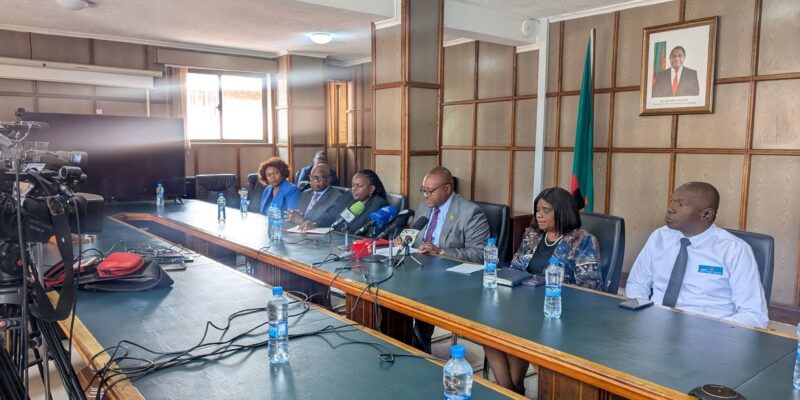
The Zambian government has rejected farewell remarks by outgoing United States Ambassador Michael Gonzales, saying they were inconsistent with diplomatic norms and violated the Vienna Convention on Diplomatic Relations.
Foreign Affairs and International Cooperation Minister, Mulambo Haimbe, said the comments were “deeply regrettable” and “undiplomatic,” arguing they undermined mutual respect between sovereign states.
Haimbe made the remarks during a media briefing in Lusaka on Monday, responding to Gonzales’ statement delivered at a farewell reception on April 30, 2026.
He said the ambassador’s comments violated the Vienna Convention on Diplomatic Relations of 1961, specifically Article 3 on diplomatic mission functions and Article 41 on non-interference in internal affairs.
“The remarks by the outgoing Ambassador violate, inter alia, Article 3 of the Convention which stipulates the functions of a diplomatic mission and Article 41 which requires diplomats to not only respect the laws and regulations of the Receiving State, but also not to interfere in the internal affairs of the host,” Haimbe said.
He added that the remarks were made at a social event and were not communicated through official diplomatic channels.
“Further, and characteristic of the outgoing Ambassador’s approach during his tour of duty, the remarks, which were delivered during a social event, have not been communicated to the Ministry of Foreign Affairs and International Cooperation by way of an official complaint or demarche or otherwise,” he said.
Haimbe rejected suggestions that Zambia’s relations with the United States are centred on aid.
“To start, it is important to clarify that contrary to the statement by the outgoing Ambassador, the relationship between Zambia and the United States is not, nor has it been, ‘centred around aid’,” he said.
He said bilateral relations since independence in 1964 have been based on “shared values, unconditional friendship and mutual respect for one another as sovereign states.”
On stalled negotiations over a proposed health memorandum of understanding worth up to US$2 billion over five years, Haimbe said Zambia had rejected certain terms, including provisions relating to data sharing.
“For clarity, the Zambian government wishes to state unequivocally that the stalled negotiations on the Health MOU are as a consequence of the incorporation of terms that the Zambian government considers unacceptable such as those relating to sharing of data in violation of our citizen’s right to privacy,” he said.
On critical minerals cooperation, Haimbe said Zambia objected to preferential treatment for US companies and linking of agreements.
“Key among the reasons for Zambia’s reluctance to accept the terms of the proposed agreement is the insistence on preferential treatment of US companies over Zambia’s critical minerals,” he said.
The minister said government had increased domestic health funding since 2021, adding that allocations in the 2026 budget were 30 percent higher than in 2025.
He also said 156 arrests had been made in health commodity theft cases, resulting in 76 convictions, while US$30 million had been recovered and forfeited to the state.
“While the outgoing Ambassador insists on misleading the world that no tangible arrests have been made in over a year, the truth is that 156 arrests have been made across the Country to date resulting in 76 convictions,” he said.
Haimbe said Zambia remained open to engagement but would not accept narratives that undermine its sovereignty.
“Zambia remains an independent nation whose sovereignty, laws and regulations must be respected,” he said.
He added that the end of the ambassador’s tenure presented an opportunity to reset relations between the two countries.
On Thursday, April 30, 2026, Gonzales accused successive Zambian governments of corruption, aid dependency, and an abdication of responsibility.
Gonzalez warned that Washington could no longer justify massive aid budgets without fundamental change.
The Ambassador said decades of American assistance had delivered measurable gains, including HIV epidemic control, a 20-year increase in life expectancy, and sharply reduced malaria deaths.
But he argued that systemic theft and government inaction had undermined those investments.
Gonzalez said the fragility of Zambia’s health system was exposed last year when the U.S. paused funding to review assistance programs.
“Despite over $7 billion in U.S. health assistance since 2000 and the hard work of many Zambians alongside us, that crumbling system revealed that while we thought we were building capacity, successive Zambian governments had not built systems,” he said.
The Ambassador accused Zambian officials of diverting government funds “to their own pockets” while “letting the United States pay for healthcare.”
WARNING! All rights reserved. This material, and other digital content on this website, may not be reproduced, published, broadcast, rewritten or redistributed in whole or in part without prior express permission from ZAMBIA MONITOR





Comments