
 By
By 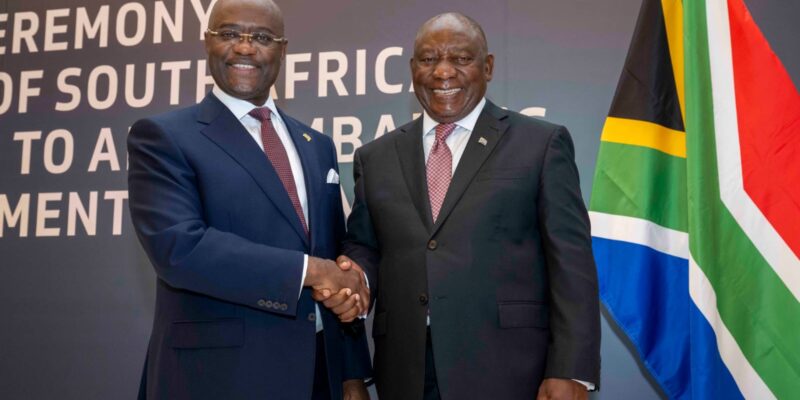
South Africa has formally joined the African Export-Import Bank (Afreximbank), in a move hailed as a defining step toward deeper African economic integration, accelerated industrialisation, and stronger implementation of the African Continental Free Trade Area (AfCFTA).
The ceremony held on Wednesday in South Africa brought together South African President, Cyril Ramaphosa, Afreximbank President George Elombi, senior government officials,and business community, all of whom described the accession as a moment that would reshape Africa’s economic trajectory for generations.
Afreximbank President, George Elombi, said that South Africa’s membership represented both a duty and a historic milestone.
He described the ceremony as a moment of “performing the traditional rites of membership of the clan,” and affirmed that the continent could not fully realise its ambition for structural transformation in trade without South Africa’s full participation.
Elombi stressed that South Africa was being welcomed into the core of the bank’s vision of a continent that produces, processes and trades in value-added goods rather than exporting raw materials.
He announced that Afreximbank had prepared an initial investment package of US$8 billion for South Africa, aligned with the country’s national development plans and industrialisation framework.
The financing is expected to support mineral beneficiation, automotive manufacturing, industrial parks, and energy generation and transmission required to anchor industrial production.
Elombi emphasised that Africa must no longer accept situations where entrepreneurs failed to operate mining or processing plants because of inadequate power or infrastructure, saying the bank would provide the necessary support to ensure that industrialisation was not hindered by energy shortages or lack of production facilities.
Elombi also highlighted Afreximbank’s past and ongoing commitments to South Africa, including the US$1 billion South Africa–Africa Trade and Investment Promotion Programme, financing participation in the US$24 billion Mozambique liquefied natural gas project, and a US$175 million investment in a titanium dioxide manufacturing plant in Richards Bay.
He said the bank’s project pipeline in South Africa already exceeded US$6 billion, with initiatives spread across financial services, healthcare, manufacturing, industrial development and mining.
President, Cyril Ramaphosa, described the accession as “logical, overdue and transformative,” arguing that South Africa should have been part of Afreximbank “ from the very beginning.”
He said the decision aligned seamlessly with South Africa’s long-term vision for continental industrialisation, stronger regional value chains and expanded export opportunities.
It is reported that once the Afreximbank–South Africa Country Programme is finalised, it will be implemented with immediate effect, carrying an initial financing package dedicated to strategic projects across manufacturing, infrastructure, export diversification and industrial development.
Ramaphosa underscored the importance of using Afreximbank’s resources to advance transformative participation in the economy, especially for black-owned businesses that were deliberately excluded under apartheid.
He noted with frustration that some who benefited from apartheid’s injustices now attempted to block black South Africans from becoming meaningful players in the modern economy.
Ramaphosa said Afreximbank’s involvement gave decisive strength to the national Transformation Fund, which will now proceed without delay.
He characterised the accession as marking a bold and ambitious new phase in South Africa’s economic engagement with Africa and the world.
The President emphasised that South Africa’s industrialisation strategy rested on three reinforcing pillars: decarbonisation, diversification and digitalisation.
He said the country was working toward an energy transition that balances climate responsibilities with developmental realities while building new industrial capabilities in renewable energy, green hydrogen, sustainable fuels and climate-resilient infrastructure.
AfCFTA Secretary-General, Wamkele Mene, said South Africa’s accession reinforces its leadership in strengthening credible African institutions capable of financing the continent’s development.
Mene described the ceremony as significant not only for South Africa and Afreximbank but also for the broader implementation of the AfCFTA.
He emphasised that the success of the AfCFTA depended not only on market access but also on the availability of trade finance to support production, industrialisation and trade-enabling infrastructure.
Mene noted that Africa was already seeing the early impact of the AfCFTA, and that Intra-African trade increased by 12.4 percent in 2024, reaching US$220 billion, driven by a shift toward value-added exports such as machinery and vehicles.
WARNING! All rights reserved. This material, and other digital content on this website, may not be reproduced, published, broadcast, rewritten or redistributed in whole or in part without prior express permission from ZAMBIA MONITOR.










Comments