
 By
By 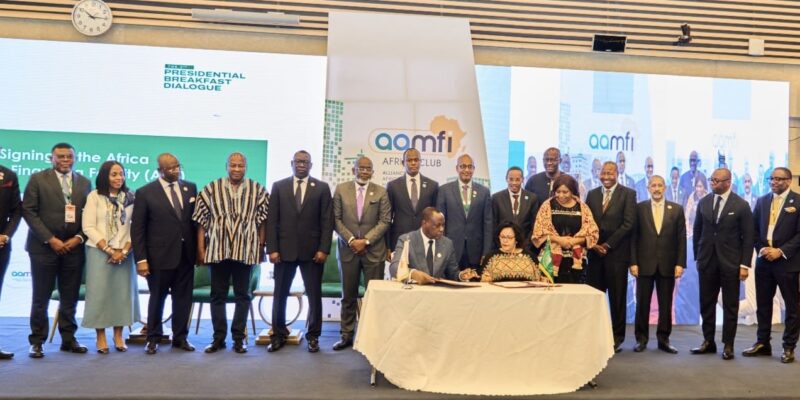
African Heads of State and Government have launched the Africa Infrastructure Financing Facility (AIFF), an Africa-led mechanism aimed at accelerating financing for priority cross-border infrastructure projects aligned with the African Union’s long-term development blueprint, Agenda 2063.
The launch took place on February 14 during the Third Presidential High-Level Dialogue of the Alliance of African Multilateral Financial Institutions (AAMFI), held on the margins of the 39th African Union Summit under the theme “Strengthening Africa’s Financial Architecture to Finance Agenda 2063.”
The Dialogue was held under the patronage of Ghana’s President John Dramani Mahama, the African Union Champion on AU Financial Institutions, who said Africa needed operational mechanisms capable of mobilising long-term capital at scale.
Read more: AFREC targets $3billion to boost energy efficiency across Africa (video)
“Africa has domestic capital pools exceeding US$2.5 trillion,” Mahama said in a statement released Thursday.
“The challenge is not the availability of capital, but how intentionally we deploy it into infrastructure, industrialization, and job creation to realize Agenda 2063 and the African Continental Free Trade Area.”
He said Africa should reduce dependence on fragmented and externally driven financing systems that frequently misprice risk on the continent.
Representing the African Union Commission, Francisca Tatchouop Belobe, Commissioner for Economic Development, Trade, Tourism, Industry and Minerals, said the Facility would help close the continent’s infrastructure financing gap.
“The launch of the AIFF is a powerful demonstration of what can be achieved when political will and institutional coordination converge,” she said. “We are confident that this Facility will contribute meaningfully to closing Africa’s infrastructure financing gap, estimated at approximately US$221 billion annually over the period 2023 to 2030,” Belobe added.
The opening remarks were delivered by Samaila Zubairu, President and Chief Executive Officer of the Africa Finance Corporation and outgoing AAMFI Chairman.
He said the alliance represented more than US$70 billion in balance sheets working jointly to close Africa’s trade, investment and development financing gaps.
“Africa’s development ambitions require scale, institutional alignment, and disciplined capital mobilisation,” he said.
Highlighting the value of the new platform, George Elombi, President and Board Chair of the African Export-Import Bank, said the Facility was designed to address the persistent gap between political approval and financial execution in infrastructure projects.
“Too many projects stall not because they lack relevance, but because they are insufficiently prepared, inadequately structured, or misaligned with the requirements of long-term capital,” he said.
Pooling expertise and risk frameworks, he added, would allow African institutions to mobilise capital at scale.
Incoming AAMFI Chair and CEO of the Africa Reinsurance Corporation, Corneille Karekezi, said Africa’s development finance must be anchored in “collaboration and innovation,” with domestic and private capital playing a greater role.
The Dialogue noted that despite strong political support for infrastructure, projects often face obstacles in early preparation phases, including limited funding, fragmented regional policies and weak coordination.
The AIFF, established under a Cooperation Framework Agreement between AUDA-NEPAD and AAMFI, will provide an Africa-led coordination mechanism to accelerate project preparation and enable indicative, non-binding engagement on financing for priority Agenda 2063 projects.
In a related development, the Republic of Cameroon deposited its Instrument of Ratification of the Protocol and Statutes of the African Monetary Fund (AMF), marking another step toward operationalising AU financial institutions intended to strengthen macroeconomic stability, balance-of-payments support and monetary cooperation among member states.
WARNING! All rights reserved. This material, and other digital content on this website, may not be reproduced, published, broadcast, rewritten or redistributed in whole or in part without prior express permission from ZAMBIA MONITOR.









Comments