
 By
By 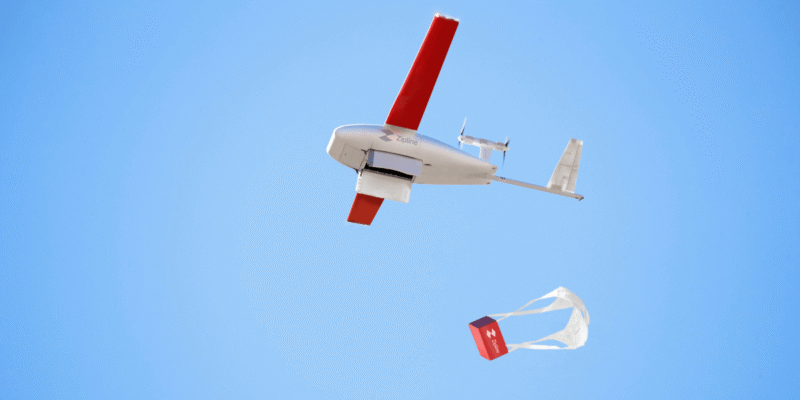
The Government of Rwanda has signed a historic expansion agreement with Zipline, marking the first milestone under Zipline’s recent $150M pay-for-performance award from the U.S. Department of State.
Building on its legacy as the first country in the world to launch Zipline’s autonomous delivery service in 2016, Rwanda will now become the first country with full nationwide autonomous logistics coverage.
It will also be the first country in Africa with Zipline’s urban delivery system, and the first country in Africa with an autonomous delivery testing center.
African Tech News reports that the expansion reinforces Rwanda’s status as a global leader in AI, robotics, and autonomous logistics, delivering cost-effective, life-saving healthcare for millions.
Rwanda will be the first in Africa to introduce Zipline’s urban delivery system, Platform 2 (P2), enabling ultra fast, quiet and precise deliveries in dense urban environments such as Kigali, where approximately 40 percent of the country’s healthcare demand is concentrated.
P2 is currently used to deliver 100,000 retail and food items in the United States with dinner plate accuracy to homes, office buildings, hotels, and public spaces
Rwanda will also add a new long-range distribution center in Karongi District, complementing Zipline’s existing hubs in Muhanga and Kayonza.
This third site will expand delivery capacity to districts beyond the Nyungwe Forest, including those bordering the Democratic Republic of Congo (DRC).
The new hub is built on the border between Rwanda and the DRC, a symbol of peace between the two countries.
Within Rwanda, the Karongi hub is expected to serve approximately 200 health posts and 60 major health facilities, reaching more than 2.9 million people.
With this expansion, Zipline’s nationwide network in Rwanda will cover over 11 million people and support ~350 local jobs.
Zipline will also establish a new AI and robotics testing facility in Rwanda — the company’s first overseas research and development hub.
The facility will support testing of aircraft performance, new safety systems, and next-generation logistics software.
The testing center in Rwanda will play a critical role in developing local talent and improving the performance of our aircraft and software in a variety of different climates and weather conditions, ensuring that technology built for the world is also built by the world.
To date, Zipline’s autonomous delivery network has enabled on-demand access to blood, vaccines, and essential medicines.
The system reduces waste, equalizes access, boosts economies, and improves health outcomes, including a 51 percent reduction in maternal deaths.
All Zipline delivery and logistics data from operations in the country integrates into Rwanda’s national health information and emergency response systems, strengthening real-time visibility, outbreak detection, and coordinated emergency response.
WARNING! All rights reserved. This material, and other digital content on this website, may not be reproduced, published, broadcast, rewritten or redistributed in whole or in part without prior express permission from ZAMBIA MONITOR.












Comments