
 By
By 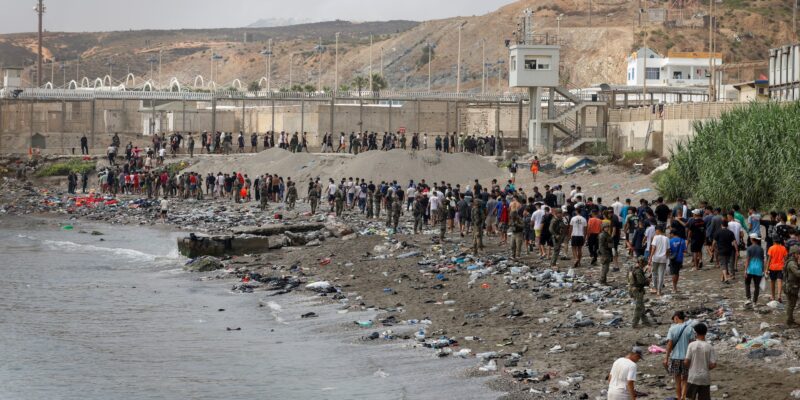
Spain has tightened security along its border with Morocco after tens of thousands of migrants crossed into the Spanish enclave of Ceuta in one of the largest mass border crossings in recent years, leaving at least 57 people dead during the journey.
Spanish authorities said about 50,000 migrants entered the North African territory within 24 hours, overwhelming the city of around 85,000 residents and triggering a political and humanitarian crisis.
However, Ceuta’s regional government estimated the number of arrivals at closer to 60,000, according to the Guardian.
Prime Minister, Pedro Sánchez, who visited the enclave on Friday, described the unprecedented influx as a violation of Spain’s territorial integrity and pledged to deploy all available resources to restore order and protect residents.
Read more: Uganda’s Kizza Besigye rushed to intensive care unit after collapsing in treason trial
Sánchez blamed human trafficking networks for encouraging the crossings following a recent ruling by Spain’s Supreme Court, which barred the immediate return of migrants intercepted at sea while attempting to reach Ceuta or the nearby Spanish enclave of Melilla.
He said criminal networks had exploited the court’s decision by spreading misinformation, prompting what he described as an “avalanche” of migrants attempting the dangerous journey.
The Spanish government announced plans to establish a temporary reception centre to register new arrivals, assess asylum claims and speed up the deportation of those without legal grounds to remain in the country.
Authorities also plan to install a line of floating buoys near Ceuta’s Tarajal beach to clearly mark the maritime border while complying with the Supreme Court ruling.
Spain’s Interior Ministry said more than 48,300 migrants had voluntarily returned to Morocco by Friday evening, while additional police officers and military personnel had been deployed to reinforce security in the enclave.
The crisis has drawn the attention of the European Union, with Ireland, which currently holds the rotating EU presidency, convening an emergency meeting of member states under the Integrated Political Crisis Response mechanism to coordinate support for Spain and discuss diplomatic engagement with Morocco.
EU ambassadors are also scheduled to meet in Brussels to assess the situation and consider further measures.
The latest surge far exceeds the previous major crossing in May 2021, when Morocco relaxed border controls, allowing about 10,000 migrants to enter Ceuta over two days.
WARNING! All rights reserved. This material, and other digital content on this website, may not be reproduced, published, broadcast, rewritten or redistributed in whole or in part without prior express permission from ZAMBIA MONITOR.






Comments