
 By
By 
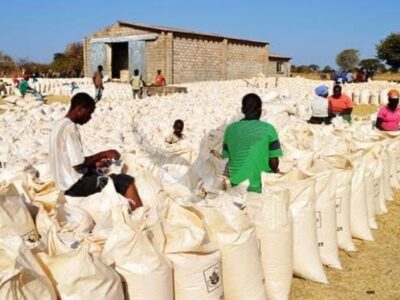
The Civil Society for Poverty Reduction (CSPR) has urged the government to prioritise urgent investment in post-harvest management of various crops in the country, including increased, community-level grain storage facilities in rural farming areas.
The group has also called for deliberate and scaled-up public investment in irrigation infrastructure, water harvesting systems, and small-scale dam construction, particularly in agro-ecological zones where climate impacts are most acute.
Isabel Mukelabai, an Executive Director with the group made the call in Lusaka on Thursday following the announcement by the Zambia Statistics Agency Zambia that the country would produce a projected bumper maize harvest of approximately 4.9 million metric tonnes for the 2025/2026 farming season.
Mukelabai noted that even where strong harvests were achieved, the risk of significant post-harvest losses posed a serious threat to the value realised from increased production.
She noted that inadequate storage infrastructure, limited access to hermetic bags and grain management technologies, poor rural road networks, and limited processing facilities across many farming areas resulted in substantial losses.
Mukelabai stated that this eroded farmer incomes and reduced the effective food supply available to households and markets.
“A bumper harvest only translates into tangible benefits for farmers if there are reliable, fair, and accessible markets to absorb the produce,” she said.
Mukelabai also raised serious concerns about the capacity of current market structures to effectively absorb a 4.9 million tonne harvest considering government’s limited budget allocation for the Food Reserve Agency.
She emphasized the need for farmers to have accessible storage solutions for smallholder farmers, strengthened partnerships with the private sector in grain handling and agro-processing and farmer training and extension on best practices in post-harvest handling and storage.
“Even as the country looks at the 10 million tonnes target by 2030, CSPR calls for a people-centred agricultural strategy that prioritises the welfare of smallholder farmers and protects vulnerable households,” Mukelabai said.
Read More: Zambia projects 4.9 million MT maize harvest, overall staple surplus for 2026/27 season
She emphasized the need for a strategy which addressed the structural risks of rain-fed agriculture through scaled irrigation investment, and tackles post-harvest losses through targeted storage and handling infrastructure.
“This marks a significant recovery for the agricultural sector and demonstrates renewed potential for Zambia to reclaim its position as a regional food basket within Southern Africa after experiencing climate related shocks in 2023/2024 season,” she said.
Mukelabai stated that the projected harvest was an important step toward strengthening national food security and reduced dependency on imports as a harvest of this magnitude if well managed had the potential to positively impact poverty levels.
She noted that this was through increased rural incomes, improved household food availability and enhanced economic activity along agricultural value chains.
“Increased production can contribute to further lowering food inflation which had remained within a double digit for the past 2 years and guarantee inflation stabilization,” Mukelabai said.
WARNING! All rights reserved. This material, and other digital content on this website, may not be reproduced, published, broadcast, rewritten or redistributed in whole or in part without prior express permission from ZAMBIA MONITOR.











Comments