
 By
By 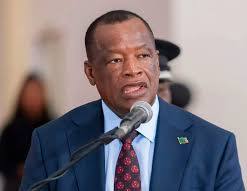
The government has warned against attempts to politicise the summoning of Lusaka Archbishop Alick Banda by the Drug Enforcement Commission (DEC), saying the matter is strictly between law enforcement and the individual concerned.
Addressing journalists on Sunday, Minister of Home Affairs and Internal Security, Jack Mwiimbu, said the Archbishop has been summoned to appear before the DEC on Monday, January 5, 2026, in his personal capacity and not as a representative of the Catholic Church.
“This matter has nothing to do with the Catholic Church. It is a matter between the Drug Enforcement Commission and Archbishop, Alick Banda, as an individual,” Mwiimbu said, emphasising that no one is above the law.
He noted that the Constitution obliged every citizen to cooperate with lawful investigations. “Under Article 43(1)(f), every Zambian is required to cooperate with law enforcement agencies. That is a constitutional requirement,” he said.
Mwiimbu warned that calls by political actors and members of the public to gather at DEC offices would be unlawful.
“Law and order will prevail.
The Public Order Act is still in force, and anyone wishing to engage in public processions must notify the police,” he said, adding: “I call upon all law-abiding citizens not to participate in illegal gatherings.”
The minister recalled that President Hakainde Hichilema, while in opposition, appeared before police more than 15 times without mobilising supporters, noting that law enforcement strictly enforced regulations at the time.
“The police were firm. They never allowed anyone to appear in support. That was the order of the day,” Mwiimbu said.
He said Archbishop Banda’s appearance before the DEC would follow lawful procedures, with the Commission determining who may accompany him, including legal representatives and, if permitted, bishops.
Mwiimbu said political processions or mass mobilisation would not be allowed.
“This issue is being politicised, and that is not acceptable. The Archbishop is a religious leader. He is not a political player,” Mwiimbu said, rejecting claims that the government was targeting the Church.
He reassured the public that religious activities, including prayers, would not be interfered with.
“No one will interfere with prayers. That right is guaranteed,” Mwiimbu said, adding that security agencies would provide protection to ensure public safety while due process is followed.
The minister confirmed that government had received a letter from the Zambia Conference of Catholic Bishops seeking dialogue and said President Hichilema was open to engagement.
“As the President has stated, dialogue is the only way forward. Government looks forward to engaging the Church on issues of national interest,” Mwiimbu said.
“We are one Zambia, one nation. Let us allow the law to take its course in a calm and orderly manner,” he said.
A consortium of 10 civil society organisations has defended the Drug Enforcement Commission’s (DEC) decision to summon the Archbishop of Lusaka over a motor vehicle allegedly linked to the Zambia Revenue Authority (ZRA), stating that religious office does not place any individual above the law.
Addressing a press briefing held at Mika Hotel in Lusaka on Sunday, Consortium Chairperson, Isaac Mwanza, said the investigation should not be framed as an attack on the Catholic Church or an attempt to silence its prophetic voice, as suggested by the Zambia Conference of Catholic Bishops (ZCCB).
Mwanza said while expressions of solidarity by the Church were understandable, they must not be interpreted as efforts to interfere with a lawful investigative process.
He said the law addresses conduct, not status, title, or ecclesiastical authority, and that no individual is exempt from accountability under the rule of law.
The consortium said legitimate questions had arisen following disclosures made in court proceedings linked to the former ZRA Commissioner General, where it was alleged that the motor vehicle was initially intended for a ZRA employee under a purchase arrangement but later ended up in the possession of the Archbishop.
Mwanza said issues requiring clarification included how the vehicle changed ownership, who facilitated its registration, what documentation was used, and whether lawyers or other professionals were involved in the transaction.
“These are questions of accountability, not persecution,” he said, adding that answering them was consistent with transparency and could help establish whether wrongdoing occurred.
The consortium said both Zambian law and Catholic canon law require clergy to uphold legal and ethical standards, noting that canon law treats the misappropriation or improper handling of gifts as a serious offence.
Mwanza cited a recent case in which Archbishop Alick Banda suspended a Catholic priest following the death of a girl at a priest’s residence, a process that later resulted in the priest being cleared, as an example of respect for due process within the Church.
He emphasised that being summoned for questioning does not imply guilt, but is a lawful step in establishing facts, adding that the Constitution guarantees the presumption of innocence and equal application of the law.
Mwanza said the only constitutionally recognised immunity from prosecution applies to the sitting President, and that clergy, like all citizens, are subject to investigation where questions arise.
He added that the Constitution obliges all persons to cooperate with lawful investigations by state institutions, including the DEC, while also protecting individuals from abuse of process.
The consortium urged the public to remain calm and avoid speculation as the matter unfolds, while encouraging the DEC to communicate more clearly within the limits of the law to prevent misunderstandings and unnecessary tension.
It also called on the ZCCB to complement state investigations with internal canonical processes provided for under Church law, noting that accountability mechanisms already exist within the Catholic Church for matters involving bishops.
Mwanza said the matter should not be interpreted as a sign of strained relations between the Church and the State, adding that lawful engagement between religious leaders and state institutions should strengthen public confidence in justice and accountability.
He said the moral authority of the Church is best preserved through patience, transparency and respect for due process, rather than public pressure or institutional mobilisation.
The consortium said that faith and the rule of law are complementary pillars of a just society, and that allowing investigations to proceed fairly and independently would reinforce public trust in both civic and religious institutions.
WARNING! All rights reserved. This material, and other digital content on this website, may not be reproduced, published, broadcast, rewritten or redistributed in whole or in part without prior express permission from ZAMBIA MONITOR.



Comments