
 By
By 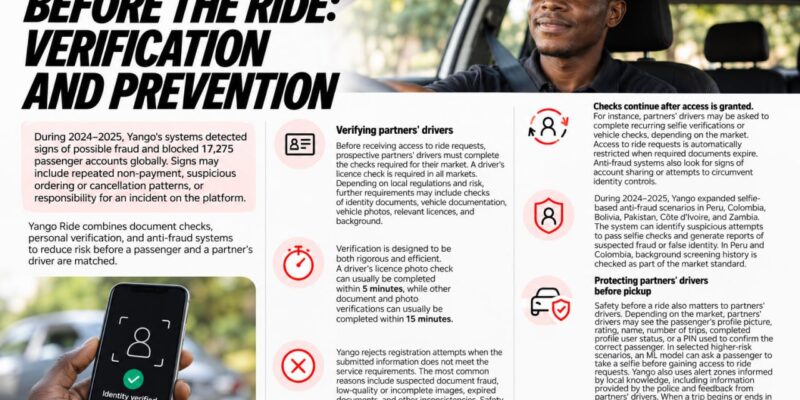
For many passengers, a ride-hailing journey begins with opening an app, entering a destination and requesting a vehicle. Behind that simple interaction, however, is a wider system of verification, monitoring, feedback and human support designed to help manage safety before, during and after a trip.
Yango Ride’s 2024–2025 Safety Report points to measurable changes in safety indicators across its markets. In Zambia, reported reckless-driving incidents declined by 49% between 2024 and 2025, while across Africa the reduction was 38%. The figures refer specifically to incidents reported through Yango’s service and should not be interpreted as national road-accident statistics.
Safety begins before a passenger enters the vehicle. Prospective partner drivers are required to complete relevant verification checks before gaining access to ride requests, including driver’s licence verification, while additional checks can include identity documents, vehicle documentation and vehicle photos. In Zambia, Yango also expanded selfie-based anti-fraud controls during 2024–2025 to help identify suspicious attempts to bypass identity checks or use false identities.
Read more: Reckless driving incidents fall by 38% across Africa, new Yango ride safety report finds
During a journey, Yango’s safety framework uses tools designed to improve visibility and help identify potential risks. Route Monitoring can detect unusual trip patterns such as route deviations or extended stops, while features including Route Sharing, Trusted Contacts and access to support can give users greater control during a trip. After the journey, passenger ratings and reports can be considered alongside technology-based signals. Driving Style uses accelerometer data to identify repeated sharp manoeuvres, while Speed Control uses GPS data to identify recurring speeding patterns rather than responding to a single isolated event.
Privacy is also part of the wider safety approach. Technologies such as In-App Calls, Number Masking and Hide My Number are designed to allow passengers and partner drivers to communicate without necessarily revealing permanent personal contact details. According to the latest data, post-trip contact complaints declined by 4% in Zambia following the continued rollout of privacy-protecting call technologies.
Yango’s approach in Zambia also extends beyond the app. In October 2025, the company launched a Driver Safety and Conduct Training Programme in Lusaka, implemented by Copper Rose Zambia, with over 50 partner drivers participating in sessions covering defensive driving, road-incident prevention, stress management and professional conduct.
The company has also worked with the Zambia Road Safety Trust on the Safer Journeys to School initiative. The programme initially covered five schools in Lusaka and reached approximately 8,000 learners, combining road-safety education with physical interventions such as zebra crossings, speed humps, road markings and warning signs. In-app school-zone alerts were also introduced to remind partner drivers to slow down near participating schools.
The report’s findings suggest that safer mobility is not built through one feature alone. For Zambia, the 49% reduction in reported reckless-driving incidents reflects a broader approach that combines technology, verification, feedback, human support, training and local road-safety initiatives to create greater visibility and accountability throughout the journey.
WARNING! All rights reserved. This material, and other digital content on this website, may not be reproduced, published, broadcast, rewritten or redistributed in whole or in part without prior express permission from ZAMBIA MONITOR.










Comments