
 By
By 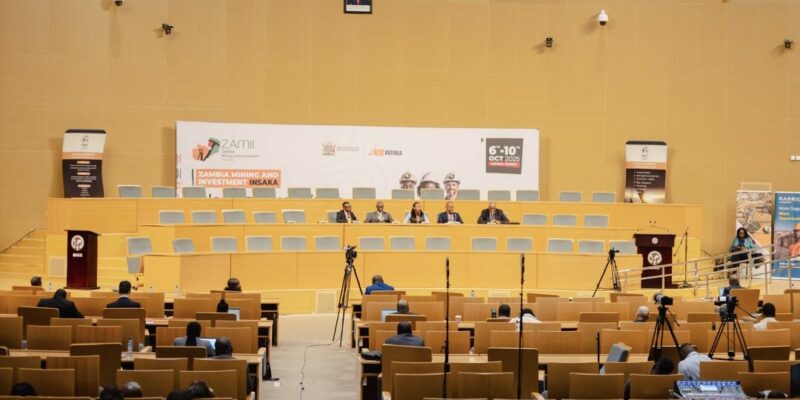
Experts have called for enhanced digital systems, transparency, and regional cooperation to tackle revenue leakages in Africa’s mining sector, stressing that better data integration and oversight were vital for countries to capture full value from their mineral resources.
Speaking during a panel discussion on “Revenue Leakages from African Mining: Strategies for Maximizing Value and Returns” at the Zambia Mining and Investment Insaka held at the Mulungushi International Conference Centre in Lusaka on Tuesday, Zambia Revenue Authority (ZRA) Commissioner for Domestic Taxes, Richard Kapasa, said the Authority had intensified reforms aimed at improving transparency and closing tax loopholes in the mining industry.
“Our mandate as the revenue authority is to ensure that every tax legally due to government is collected,” Kapasa said.
Read more: ZANACO boosts financial inclusion for mining SMEs with $50 million facility
He explained that ZRA was strengthening audit systems, enhancing cross-border collaboration, and improving data sharing to minimise losses in the sector.
“In the mining sector, we are strengthening audit systems, improving cross-border collaboration, and enhancing data sharing to close loopholes that lead to revenue losses,” he added.
According to ZRA data, the mining sector contributed about K41.7 billion to government revenue in 2024, representing 28.1 percent of total gross tax collections.
This declined by 2.6 percent from 30.7 percent of the total collections in 2023.
Despite the decline, Kapasa said the mining industry remained Zambia’s largest revenue earner, accounting for 28.1 percent of gross tax collections in 2024, ahead of manufacturing, financial services and public administration.
The sector also supports an estimated 90,000 direct and indirect jobs.
He attributed the lower contribution to challenges such as transfer pricing, profit shifting, under-declaration of mineral grades, and limited information exchange among regulatory bodies.
“We continue to face challenges of transfer pricing and profit shifting, where profits are moved to low-tax jurisdictions,” he said, adding , “Other issues include under-reporting of mineral content and weak information sharing between oversight institutions.”
To enhance oversight, Kapasa revealed that ZRA had established a dedicated Mining Tax Office focusing on both large- and medium-scale mining operations to improve compliance and service delivery.
“We have set up a specialised department with units targeting different categories of mining taxpayers,” he explained. “This helps us expand the tax base, support compliant operators, and take firm action against evasion.”
On tax compliance, ZRA data shows that large mining companies have an average filing compliance rate of 87 percent, compared to 58 percent among small and medium-scale miners. For tax payments, compliance stands at 47 percent, with most payments made within days after the due date.
Kapasa said ZRA was now conducting joint customs–domestic tax audits and rolling out digital data-integration systems to enhance transparency and curb illicit financial flows.
Adding a regional perspective, Kwabena Barning, Chief Technical Officer at the Minerals Income Investment Fund (MIIF) said Ghana had implemented similar control measures through the creation of a National Assay Office, which tests and grades all mineral products before export.
“The Customs Division of the GRA is present in gold refineries, collating data on every single production batch. This ensures that production, turnover and income figures reported by companies align with reality,” Barning said.
He added that Ghana was also strengthening its capacity to audit and validate mineral-trading contracts to prevent under-declaration and transfer-pricing manipulation.
“We are not saying mining companies are deliberately under-declaring, but by empowering our audit teams and validating contracts, we can ensure fees and rates reflect the true value of exports,” Barning added.
Milika Mushota, Lead Researcher at Vonsé Energy, underscored the importance of digitalisation and system integration as practical solutions to curb leakages in the mining value chain.
“From our research and audits, digitalisation is key. We need centralised data systems that connect customs, mining companies and revenue authorities.
“By digitising operations and implementing the Internet of Things, we can trace minerals from the extraction site all the way to export,” Mushota said.
She added that such technological integration would help detect irregularities, strengthen accountability, and reduce illegal mining activities across the continent.
“If we can trace information from where the mining happens up to where it is processed or exported, it becomes easier to detect irregularities and ensure accountability,” Mushota said.
The panelists agreed that digital transformation, regional cooperation and institutional strengthening were critical if African countries are to maximise value from their mineral resources and boost domestic revenue mobilisation.
WARNING! All rights reserved. This material, and other digital content on this website, may not be reproduced, published, broadcast, rewritten or redistributed in whole or in part without prior express permission from ZAMBIA MONITOR.








Comments