
 By
By 
Zambia’s economy grew by 5.4% in 2025, accelerating from 3.8% in 2024, while annual inflation eased slightly to 6.1% in September 2026, the Zambia Statistics Agency (ZamStats) said on Thursday.
The final annual gross domestic product (GDP) estimates at constant 2010 prices represented a 1.6 percentage-point increase in economic growth from the previous year.
Statistician General, Sheila Mudenda, said the growth was mainly driven by five industries that recorded positive contributions, led by information and communication at 1.8%, agriculture, forestry and fishing at 1.5%, mining and quarrying at 0.8%, construction at 0.4% and transport and storage at 0.4%.
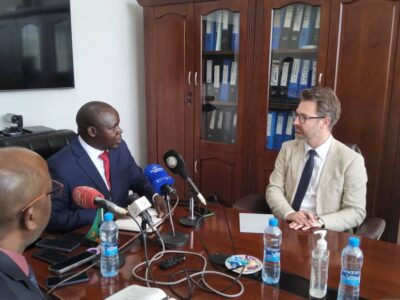
Mudenda was speaking during the dissemination of the September statistical bulletin in Lusaka.
“The final 2025 GDP at current prices has been estimated at K797,707 million compared to K663,775 million in 2024.comprises the following main categories; Final Consumption Expenditures, Gross Capital Formation and Net Exports of goods and services,” Mudenda said.
GDP measured by expenditure was estimated at K785,901 million in 2025, compared with K662,094 million in 2024, with final consumption expenditure accounting for the largest share at 64.9%, she said.
Read More: Zambia’s July inflation holds at 6.5%, trade surplus narrows
Gross capital formation accounted for 33.1% of GDP in 2025, up from 23.8% in 2024, while exports of goods and services increased to 44.1% from 35.0%.
The share of imports of goods and services also increased to 41.3% from 27.6%, while household final consumption expenditure rose slightly to 47.3% from 47.1%.
On inflation, Mudenda said annual inflation eased to 6.1% in September from 6.2% in August.
This means prices of goods and services increased by an average 6.1% between September 2025 and September 2026.
She said annual food inflation declined to 5.8% from 6.0% in August, driven mainly by price movements in cereals, vegetables, groundnuts and dried beans.
Mudenda said annual non-food inflation remained unchanged at 6.6%.
ZamStats attributed non-food price movements mainly to passenger air transport, including domestic and regional air fares and the Lusaka-London route via Dubai, as well as vehicle purchases.
Inflation declined in Central Province to 5.6% from 5.8%, Copperbelt to 5.3% from 5.6%, Lusaka to 8.1% from 8.3%, Northern to 5.6% from 5.7%, North-Western to 5.0% from 5.5% and Western to 5.2% from 5.4%.
She said inflation increased in Eastern Province to 4.9% from 4.8% and Southern Province to 5.6% from 5.4%, while it remained unchanged in Luapula at 4.3%.
Mudenda said Lusaka Province accounted for the largest contribution to the national annual inflation rate, at 2.3 percentage points, followed by Copperbelt at 1.1 percentage points.
She said Central and Southern provinces each contributed 0.6 percentage points, while Luapula, North-Western and Western provinces each contributed 0.2 percentage points.
WARNING! All rights reserved. This material, and other digital content on this website, may not be reproduced, published, broadcast, rewritten or redistributed in whole or in part without prior express permission from ZAMBIA MONITOR.









Comments