
 By
By 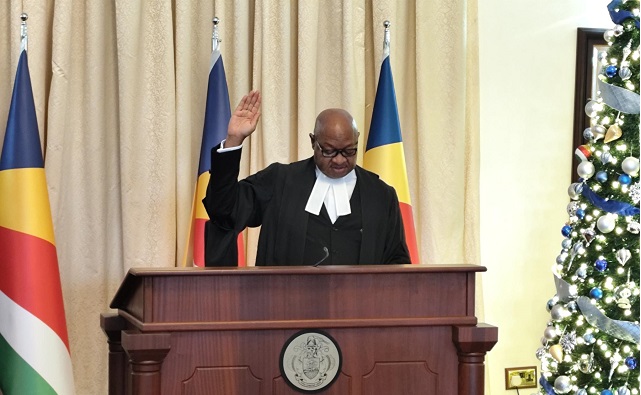
The Magistrates’ and Judges’ Association of Zambia (MAJAZ) has filed its substantive submissions before the Constitutional Court in a case concerning the interpretation of Article 142(6) of the Constitution – a provision that governs whether judges who accept appointments outside the Judiciary must resign their domestic office.
MAJAZ, through its National Secretary, Allan Ngobola, was granted leave on Monday, 8 June 2026 to join the proceedings as the Second Applicant.
The Association is represented by former Attorney General, Musa Mwenye, SC, of Mwenye & Mwitwa Advocates.
The underlying matter was brought by former Court of Appeal Judge Dominic Yeta Sichinga, represented by another former Attorney General, Likando Kalaluka.
Justice Sichinga and Justice Nicola Ann Sharpe-Phiri resigned from the Zambian bench after accepting non-resident appointments to the Court of Appeal of Seychelles.
Justice Sichinga’s resignation has triggered a direct constitutional question: whether such part-time foreign judicial service falls within the resignation requirement under Article 142(6).
In its filed submissions, MAJAZ urges the Court to reject a literal reading of the word “office” in Article 142(6), arguing that such a construction “would lead to an absurdity and an undesirable outcome far outside the intents and purposes” of the provision.
The Association points out that Zambian judges have historically chaired Commissions of Inquiry, headed the Electoral Commission of Zambia, lectured in law schools, and served on international tribunals – “all of which have required impartiality and the very judicial temperament being a judge demands.”
Drawing on the Ugandan Constitutional Court’s decision in Hon. Jim Muhwezi and 3 Others v Attorney General, MAJAZ proposes a purposive test: the “office” envisaged by Article 142(6) should be one that is inconsistent with the judicial oath and would interfere with the independence of the judge or the Judiciary.
On that test, ad hoc international judicial service — far from compromising independence — enriches the Zambian bench through comparative jurisprudence and peer engagement.
Read More: Judges Association moves to join Constitutional Court case on external appointments
MAJAZ further warns of a structural consequence: a narrow construction “would also work as a disincentive for recruitment of suitable candidates for appointment as Judges,” at a time when the Judiciary is already grappling with retention and recruitment challenges.
The Association invokes the Constitutional Court’s own jurisprudence in The People v John Sinkamba and Others, where the Court cited former President of the Supreme Court of Israel Aharon Barak’s Purposive Interpretation in Law in support of a broad-based constitutional reading that gives effect to “the character and aspirations that shape society.”
Following the joinder, Judge President Hon. Justice Prof. Margrete Munalula has issued Orders for Directions setting a tight filing timetable: MAJAZ’s submissions were due by 18 June, with the 1st Applicant and the Attorney General to file responses by 25 June, and MAJAZ’s reply by 2 July.
A compliance hearing has been set for 3 July 2026.
As the matter progresses, scholars, practitioners and judicial officers across the Commonwealth are watching closely.
The case was widely regarded as a defining moment for the balance between Zambia’s constitutional safeguards and the modern realities of cross-border judicial cooperation.
WARNING! All rights reserved. This material, and other digital content on this website, may not be reproduced, published, broadcast, rewritten or redistributed in whole or in part without prior express permission from ZAMBIA MONITOR.







Comments