
 By
By 
Zambia Revenue Authority (ZRA) Commissioner-General, Dingani Banda, says revenue mobilisation remains under pressure due to the dominance of the informal sector, prompting the authority to roll out data-driven reforms aimed at widening the tax base and improving compliance.
To address this, Banda said ZRA is implementing a data-driven tax administration model aimed at expanding the tax base, simplifying compliance requirements and payment platforms, and strengthening taxpayer outreach and education through the Taxpayer Services and Education Department.
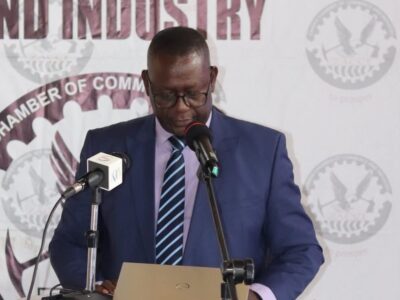
He was speaking during a presentation at a town hall meeting on the 2021–2025 economic performance and the 2026 budget and economic outlook on Thursday.
“Among the new measures introduced are Advance Income Tax on transactions exceeding US$2,000 for taxpayers without a valid Tax Clearance Certificate, as well as the Mobile Money Levy.
Read more: Zambia Revenue Authority strengthens integrity drive with new investigators
Strategic system interfaces with other institutions are also being implemented to uncover hidden non-compliance,” Banda said.
He also highlighted progress in clearing the backlog of unpaid Value Added Tax (VAT) refunds, which had previously constrained private sector liquidity.
Banda explained that reforms such as First-In-First-Out (FIFO) processing, risk-based refund assessments and enhanced Smart Invoice controls had significantly increased monthly VAT refund disbursements.
“Monthly VAT refunds were raised from an average of K850 million to a non-negotiable K1.35 billion from November 2021, increased further to K1.7 billion in September 2024, and then to between K2.2 billion and K2.5 billion per month by February 2025,” he said, adding that the reforms have helped unlock liquidity for businesses.
To curb tax evasion and avoidance, Banda said ZRA has strengthened risk-based audits, rolled out data-driven compliance tools and begun exchanging tax information with other countries.
He added that the authority was receiving technical assistance to improve the use of exchanged information during audits.
Efforts to combat illicit mining had also been stepped up through enhanced multi-agency enforcement and tighter monitoring of mineral supply chains.
“As a result of the administrative reforms, Zambia recorded a modest improvement in tax compliance, with average compliance rising to 49 percent in 2025 from 42 percent in 2024,” Banda said.
WARNING! All rights reserved. This material, and other digital content on this website, may not be reproduced, published, broadcast, rewritten or redistributed in whole or in part without prior express permission from ZAMBIA MONITOR.










Comments