
 By
By 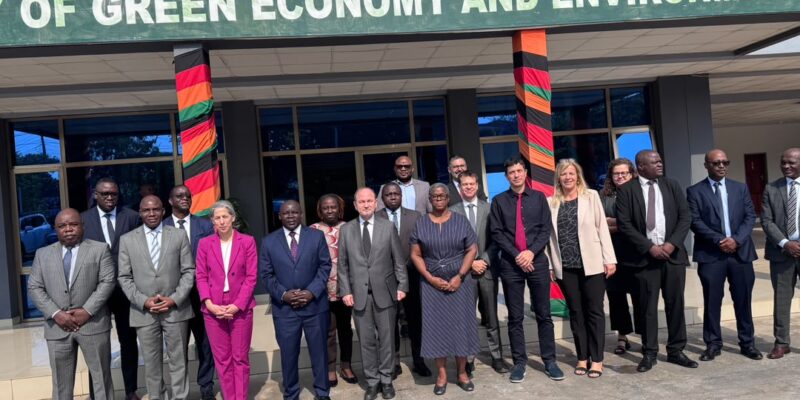
Zambia has urged the World Bank Group to accelerate green investments along the Lobito Corridor and strengthen climate preparedness as the country braces for an anticipated El Niño event.
Minister of Green Economy and Environment, Gilbert Siame, said on Friday that the corridor presented a major economic opportunity as Zambia pursued its target of producing three million metric tonnes of copper annually by 2030.
Siame was speaking when he received a World Bank Group delegation led by Anna Wellenstein, Regional Practice Director for the Planet Department in the Eastern and Southern Africa Region, at his office in Lusaka.
The delegation included Firas Raad, Division Director for Malawi, Tanzania, Zambia and Zimbabwe; Martine Valcin, World Bank Country Manager; and Frauke Jungbluth, Practice Manager for Agriculture and Food.
“If infrastructure and mining expansion proceed without integrated land use planning and cumulative impact management, we risk undermining the very natural capital that sustains economic growth,” Siame cautioned.
He welcomed the World Bank’s support for the proposed Lobito Forest Economy Programme ahead of a mission scheduled for November 2026, while reiterating the need to move quickly from planning to investments on the ground.
Siame also called for continued cooperation in mobilising climate finance, strengthening carbon market readiness under Article 6 of the Paris Agreement, and improving measurement, reporting and verification systems.
He further highlighted the need to strengthen digital environmental data systems and build the capacity of the Zambia Environmental Management Agency (ZEMA) and the Forestry Department.
Describing Zambia’s relationship with the World Bank Group as long-standing and strategic, Siame said the partnership had evolved from supporting core development priorities to advancing resilience, sustainability and economic transformation under President Hakainde Hichilema’s Grow Zambia agenda.
“Zambia recognises that environmental sustainability is not peripheral to development; it is foundational to it,” Siame said.
He said recurring droughts, floods and land degradation were eroding development gains in agriculture, water, energy, forestry and livelihoods.
In response, Zambia had adopted a green growth pathway centred on integrated landscape management, climate-smart agriculture, stronger forest governance, participatory land-use planning, climate finance mobilisation and resilient infrastructure.
Siame commended the World Bank’s support for Zambia’s forestry and landscape programmes, particularly the Eastern Province Jurisdictional Sustainable Landscape Programme (EP-JSLP), valued at about US$43 million.
The programme targets nearly 29 million tonnes of carbon dioxide emission reductions by 2030, with 55 percent of its revenues directed to communities.
He also cited the US$137 million Transforming Landscapes for Resilience and Development Phase II (TRALARD II) project, which he said was entirely grant-funded and reflected international confidence in Zambia’s environmental governance.
Read More: Afreximbank sees Lobito Corridor boosting regional integration, trade
“TRALARD II is not merely a project; it is a flagship reform platform. The project is implementing integrated landscape management across 32 districts, restoring degraded miombo ecosystems and institutionalising science-based land use planning,” he said.
Raad said the World Bank was committed to supporting development projects that protected natural resources, promoted sustainable livelihoods and created jobs, particularly for young people.
He said the Bank’s policies aligned with the Grow Zambia agenda and that it was working to ensure a timely response to the anticipated El Niño.
Meanwhile, Wellenstein called for stronger collaboration with the Government to develop a strategy to improve Zambia’s access to climate finance.
She said such efforts were important for job creation, particularly among young people, and identified the Lobito Corridor as a potential catalyst for employment.
Wellenstein also commended TRALARD Phases I and II and the EP-JSLP, describing them as flagship projects demonstrating the impact of cooperation between Zambia and the World Bank.
Valcin said the Bank was committed to supporting the Government’s ambitions for the Lobito Corridor, including developing the forest economy, expanding timber production and promoting value addition.
She added that the World Bank was well placed to help attract foreign direct investment into Zambia.
WARNING! All rights reserved. This material, and other digital content on this website, may not be reproduced, published, broadcast, rewritten or redistributed in whole or in part without prior express permission from ZAMBIA MONITOR.










Comments