
 By
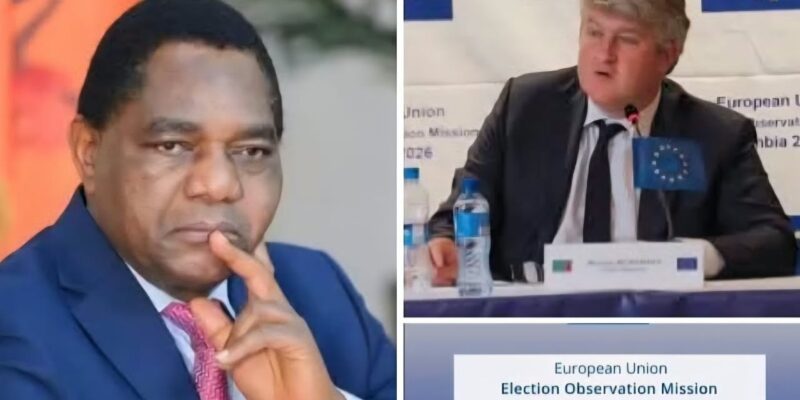
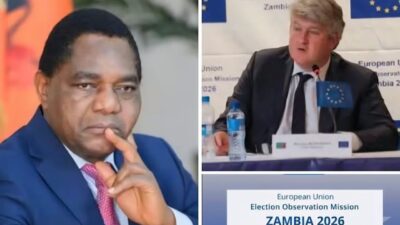
The European Union Election Observation Mission (EU EOM) has raised serious concerns over alleged police bias, political cadreism and undue advantages for the incumbent, saying these factors restricted opposition campaigning and tilted the playing field during Zambia’s August general elections.
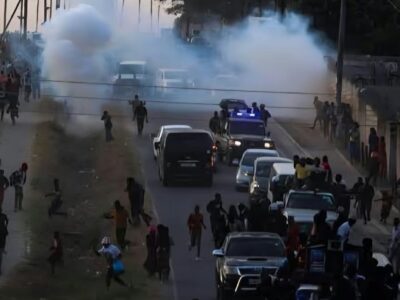
The mission said the misuse of state resources, campaign-related violence, police bias and detentions undermined fair electoral competition.
In its final report, released in Lusaka and presented to President Hakainde Hichilema, the mission found that the Electoral Commission of Zambia’s (ECZ) campaign timetable restricted opposition candidates to five-day provincial campaign windows while exempting the President and Vice-President.
Media monitoring of 10 outlets found that Zambia National Broadcasting Corporation (ZNBC) Television allocated 96.2 percent of its political airtime to the ruling party, while ZNBC Radio gave it 90.5 percent. Women accounted for only nine percent of candidates across all levels.
“The elections offered Zambians a competitive choice, and polling staff administered voting efficiently. At the same time, late legal changes and unequal campaign conditions created uncertainty and distorted the playing field,” EU EOM Chief Observer Michael McNamara said.
McNamara said the suspension of vote counting and the subsequent closure of courts curtailed transparency and access to justice, which he described as two pillars of any democratic election.
He noted that the ECZ suspended the counting and announcement of results nationwide for six hours on August 14, citing violence against polling staff and alleged ballot box theft.
“At totaling centres, EU Election Observation Mission observers saw tabulation procedures deteriorate, with less public scrutiny after that point. Serious incidents and procedural irregularities were noted by the EU EOM during the totaling process, impacting its transparency and credibility,” McNamara said.
He said the ECZ declared the presidential results on August 18, but had not published a complete set of results for public access, undermining transparency.
The mission made 13 recommendations to improve the organisation, management and conduct of elections, eight of which were classified as priority recommendations. It said the European Union stood ready to support Zambia in implementing them.
The eight priority recommendations focus on reforming the electoral legal framework, ensuring a level playing field and strengthening the credibility of election results ahead of the next polls.
They include revising the electoral legal framework well in advance through an inclusive, expert-driven process; publishing all regulatory instruments and decisions; ending the ECZ’s role in setting campaign timetables to allow contestants to determine their own schedules; and transforming ZNBC into a genuine public service broadcaster free from direct government control.
The mission also called for aligning the Cyber Security and Cyber Crimes Acts with international commitments on freedom of expression and privacy, as well as guaranteeing election observers unhindered access through a timely and less burdensome accreditation process.
Other recommendations include guaranteeing effective access to due process through realistic election petition timelines and alternative filing options, and protecting the will of voters by making results tabulation more transparent.
The latter would include projecting data entry during tabulation and promptly publishing complete results disaggregated by polling station online.
Meanwhile, Minister of Information and Media and Chief Government Spokesperson, Elvis Nkandu, said the Government was not given sufficient opportunity to provide historical, institutional and security context on several issues upon which significant conclusions appeared to have been based.
Nkandu, who disputed parts of the report, said the Government had taken note of the final assessment and appreciated some aspects of it, but argued that certain findings lacked context and risked presenting an incomplete picture of Zambia’s democratic journey.
“The report states that ZNBC was overwhelmingly biased toward the incumbent. Conclusions relating to the Zambia National Broadcasting Corporation appear to have been reached without adequately engaging the institution itself,” he said.
Nkandu said ZNBC provided commercial airtime to all political parties and stakeholders on equal commercial terms.
He said opposition parties had the opportunity to purchase airtime during the electoral period, adding that ZNBC also had a statutory responsibility to inform citizens about Government programmes, policies and public services.
“Election observation missions can only provide an assessment of what they directly observe, and do not necessarily possess access to all intelligence, security information and law enforcement investigations available to sovereign state institutions,” Nkandu said.
He assured that the Government remained committed to engaging all stakeholders, including the European Union, political parties, civil society organisations, media institutions and citizens, in strengthening Zambia’s democratic processes.
WARNING! All rights reserved. This material, and other digital content on this website, may not be reproduced, published, broadcast, rewritten or redistributed in whole or in part without prior express permission from ZAMBIA MONITOR.






Comments