
 By
By 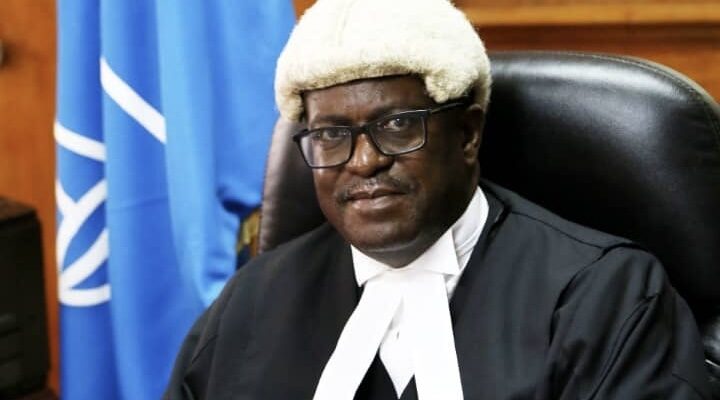
Zambia’s Judiciary said on Tuesday that the Chief Justice had received documents seeking to challenge President-elect Hakainde Hichilema’s election and referred them to the Constitutional Court, while the Secretary to the Cabinet said no presidential petition had been received by the Judiciary by the expiry of the legal filing period.
The apparently conflicting statements came a day after lawyer Linda Kasonde, governance activist Brebner Changala and LCK Freedom Foundation Limited sought to challenge the Aug. 13 presidential election, alleging that it was marred by violence, intimidation, corruption and other irregularities.
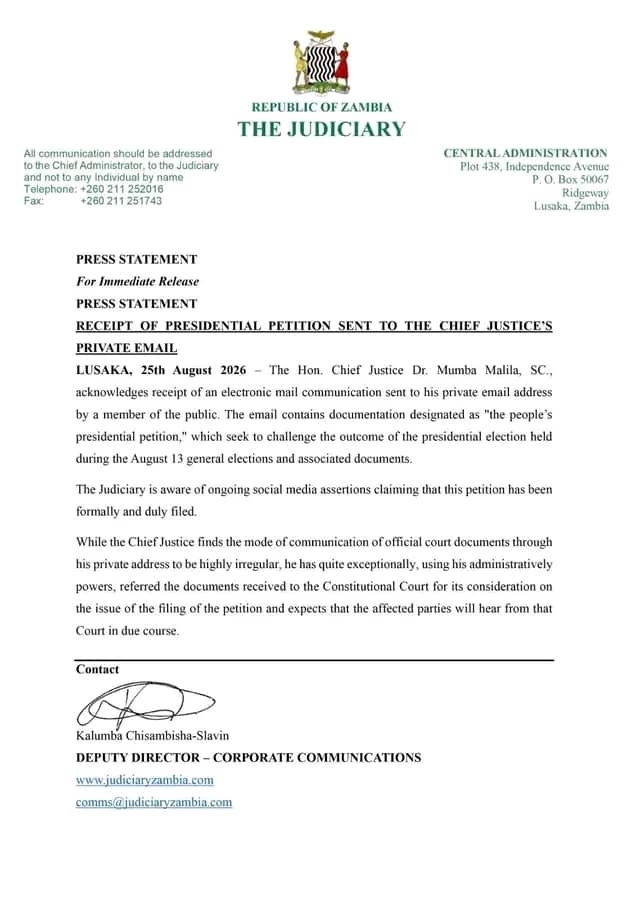
The Judiciary said Chief Justice Mumba Malila had acknowledged receiving an email from a member of the public containing documents described as “the people’s presidential petition”, together with an affidavit verifying the facts, a list of authorities and submissions.
Malila, however, considered the use of his private email address to transmit official court documents “highly irregular”.
He nevertheless exercised his administrative powers to refer the documents to the Constitutional Court to determine whether the petition had been properly filed.
The petitioners had said they attempted to file the petition electronically through the Judiciary’s designated email address on Monday, but that the email bounced back.
Kason’s subsequently emailed Malila, saying she had resorted to his private address because of the security situation at the Judiciary.
The petition names the Electoral Commission of Zambia, Attorney General Mulilo Kabesha and Hichilema as respondents.
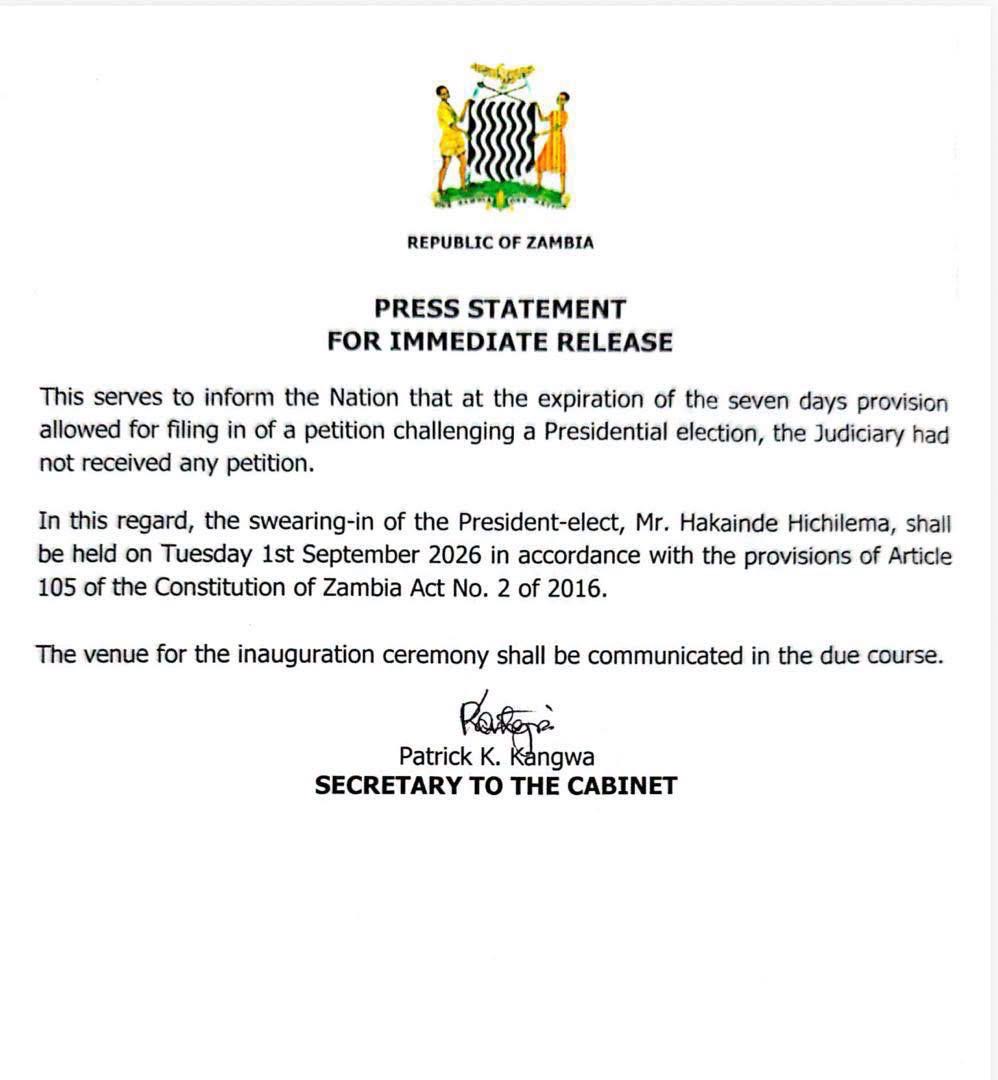
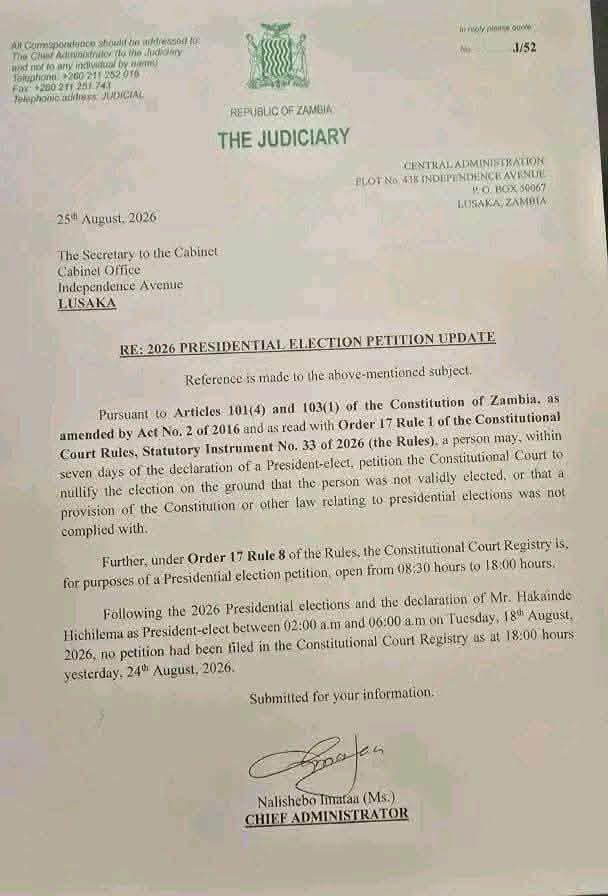
But in a separate statement, Secretary to the Cabinet Patrick Kangwa said that at the expiry of the seven-day period allowed for filing a petition challenging a presidential election, “the Judiciary had not received any petition.”
Kangwa said that, as a result, Hichilema’s swearing-in would be held on Tuesday, Sept. 1, 2026, in accordance with Article 105 of Zambia’s Constitution.
He said the venue for the inauguration would be announced later.
The differing statements leave the status of the documents submitted by Kasonde and her co-petitioners to be determined by the Constitutional Court.
The petitioners argued that they have legal standing to challenge the election under Article 2 of the Constitution and contend that the election did not reflect the sovereign will of Zambians or meet the constitutional requirement for a free and fair election.
They cite findings by the Christian Churches Monitoring Group, alleging voter inducement, the collection of voters’ cards and National Registration Card details, politically motivated violence, intimidation and restrictions on political activities.
The petitioners also alleged that supporters of Hichilema’s United Party for National Development were involved in incidents of violence and accuse the Electoral Commission of Zambia of failing to act swiftly against electoral violations.
They further challenged the deployment of the Zambia Defence Force to perform policing and internal-security functions before, during and after the election.
The petitioners alleged that recording National Registration Card numbers against ballot papers compromised the secrecy of the ballot and contravened the Constitution. They also challenged the alleged use of the Social Cash Transfer programme and other government resources to influence voters.
They are asking the Constitutional Court to declare the election unconstitutional, invalidate Hichilema’s election and nullify the declared results.
The court’s determination on whether the documents transmitted to the Chief Justice constituted a properly filed presidential petition could therefore have a bearing on whether the election challenge proceeds.
WARNING! All rights reserved. This material, and other digital content on this website, may not be reproduced, published, broadcast, rewritten or redistributed in whole or in part without prior express permission from ZAMBIA MONITOR.







Comments