
 By
By 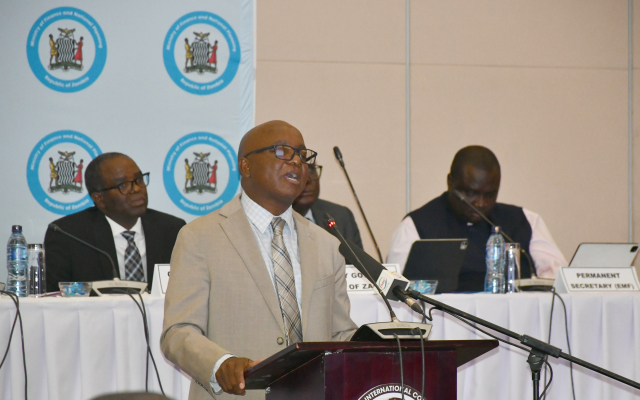
The Zambian government has announced that K4.3 billion was spent on debt servicing from the total of K21.1 billion released in July 2026 to sustain public service delivery and finance priority programmes across Zambia.
The July disbursement marks the beginning of the second half of the year and brings total Treasury releases for 2026 to K173.15 billion, following K152.05 billion released in the first six months, according to Secretary to the Treasury, Felix Nkulukusa.
Debt management remained a priority, with K4.3 billion released in July for domestic and external debt service and to dismantle domestic arrears. This brings cumulative debt-related releases to K61.2 billion.
“We are also honouring debt obligations and dismantling arrears. The fiscal credibility Zambia has rebuilt provides a stronger foundation for investment, increased production, job creation and sustainable economic growth. We are very optimistic about the future,” Nkulukusa said.
The higher outturn in the first half was partly driven by the Eurobond buyback and between January and June, K56.9 billion was released for debt service against a projection of K39.7 billion.
In a statement issued in Lusaka on Sunday, K6.3 billion was allocated to transfers, subsidies and social benefits, K5.9 billion went to the Public Service Wage Bill, K3.4 billion to government programmes and operations, and K1.2 billion to capital expenditure.
Food security and social protection received K6.3 billion for transfers pushed cumulative spending under this category to K30.2 billion for the year.
Nkulukusa said the releases were focused on direct impact to citizens.
Read More: Zambia targets 82% domestic financing of 2026 national budget
“Budget implementation is about people. Behind these figures are vulnerable families receiving social protection, farmers producing food, children benefiting from free education, retirees receiving support, institutions delivering essential services, and communities benefiting from infrastructure,” he stated.
Significant allocations were made to agriculture and food security with the Food Reserve Agency receiving K2.7 billion, while the Farmer Input Support Programme got K660 million, bringing FISP’s cumulative 2026 releases to K6.4 billion.
On education, the Treasury released K841.4 million in grants to schools to support free education, bringing cumulative releases to K2.4 billion.
“The K841.4 million released to schools brings cumulative grants supporting free education to K2.4 billion this year,” Nkulukusa said.
The Social Cash Transfer Programme received K564.2 million, taking its total for the year to K2.3 billion and Grant-Aided Institutions including hospitals and universities were given K709.3 million, with cumulative releases now at K9.6 billion. K507.3 million was also released to the Public Service Pension Fund.
On infrastructure, K1.2 billion was released for capital projects and this included K592 million for roads, K243.3 million for water, K188.9 million for rehabilitation of National Assembly buildings, K101.3 million for education infrastructure, and K50 million for mini hospitals.
“Having released K152.05 billion or over 60 percent of the 2026 budget during the first half, our focus in the second half is to sustain disciplined implementation while accelerating the conversion of available resources into stronger services, productive infrastructure, economic opportunities and improved livelihoods for the benefit of our fellow citizens,” Nkulukusa said.
The Treasury also released K5.9 billion for the wage bill, bringing the 2026 total to K37.4 billion, K3.4 billion was released for general operations, including K710 million to the Electoral Commission of Zambia for election preparations.
Addressing economic pressures, Nkulukusa noted the impact of global developments on fuel prices.
“We remain confident in our ability to manage these developments while protecting priority programmes. We will continue to prioritise expenditure, maintain fiscal discipline and direct available resources towards interventions that strengthen resilience, stimulate economic activity and improve citizens’ lives,” he stated.
Nkulukusa affirmed the Ministry’s commitment to transparency and accountability, and urged Ministries, Provinces and Spending Agencies to translate the releases into tangible results in communities across the country.
WARNING! All rights reserved. This material, and other digital content on this website, may not be reproduced, published, broadcast, rewritten or redistributed in whole or in part without prior express permission from ZAMBIA MONITOR.







Comments