
 By
By 
Barely weeks after President Hakainde Hichilema was sworn in for a second term, a social media debate over Zambia’s presidential term limits has emerged, with political commentators and some supporters of the ruling United Party for National Development (UPND) calling for the constitutional limit to be removed.
They argue that longer presidential tenure could provide continuity for Hichilema’s economic programme and allow his administration more time to implement its policies.
The debate was sparked in part by comments from Economic Liberty Party president Chilufya Tayali, who wrote on Facebook: “Removing the presidential limit-term will actually strengthen democracy, I will explain later at 20:00hrs.”
The post triggered debate among social media users, with reactions divided between those arguing that Hichilema should be allowed to continue beyond his second term and those insisting that constitutional term limits should remain in place.
Read more: Social Media Trends: Businesses cash in as Zambians wait for election results
Hichilema was sworn in for a second five-year term on Sept. 1 after winning the Aug. 13 presidential election. State House said he secured 2.97 million votes, ahead of his closest challenger Brian Mundubile, who received 1.86 million votes.
Under the current constitutional framework, the 2026-2031 mandate is Hichilema’s second term.
Some users linked the call for continuity to Zambia’s economic recovery, arguing that changing leadership could interrupt policies and programmes being implemented by the current administration.
Henry Saki said replacing Hichilema while the economy was recovering could disrupt progress.
“I tell you replacing HH at this time when Zambia’s economy is just recovering from the intensive care unit will be a grave mistake. China today is able to compete with the USA because of consistency,” he wrote.
Aaron Mumbi Mukuka also argued that presidential term limits were “only bad for bad president” and said they were suitable for a president such as Hichilema.
However, other users rejected suggestions of extending Hichilema’s tenure and questioned the implications for constitutionalism and democratic governance.
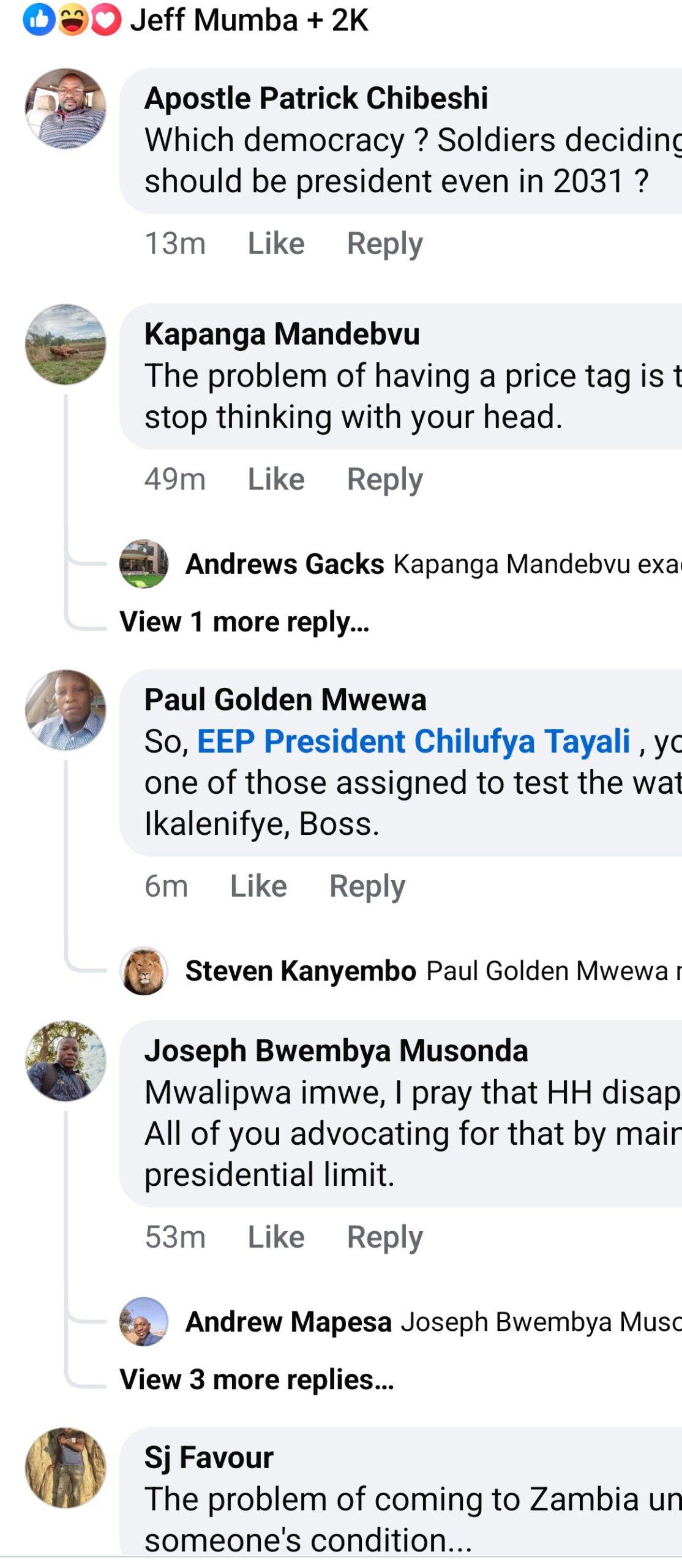
Apostle Patrick Chibeshi questioned the implications of extending presidential tenure, asking: “Which democracy? Soldiers deciding who should be president even in 2031?”
Kapanga Mandebvu, meanwhile, commented on political influence, saying: “The problem of having a price tag is that you stop thinking with your head.”
Jeff Mumba urged supporters of Hichilema not to encourage discussions about extending his tenure.
“Guys stop suggesting wrong things and pandering them to the President. He is a good leader and he done extremely well thus far. Don’t lead him into temptation,” Mumba wrote.
He suggested that the debate should instead focus on introducing term limits for members of parliament.
Other users questioned the timing of the discussion, with Martin Nkhuwa saying politicians should focus on working rather than discussing presidential tenure years before the next election.
Dyibi Chibz similarly questioned whether government would deliver on its responsibilities while discussions about constitutional amendments were already emerging.
The debate also attracted humorous reactions.
Fungai Grace Meki remarked, “It’s gonna be a good year. I can feel it,” accompanied by laughing emojis, while another user, Shipungu, responded with a series of laughing emojis.
Meanwhile, Collins Agro suggested several possible directions for Zambia’s political future, including remaining a two-party state, becoming a one-party state or having Hichilema remain in office for 20 years.
Other users invoked the experiences of other African countries in questioning the implications of extending presidential tenure.
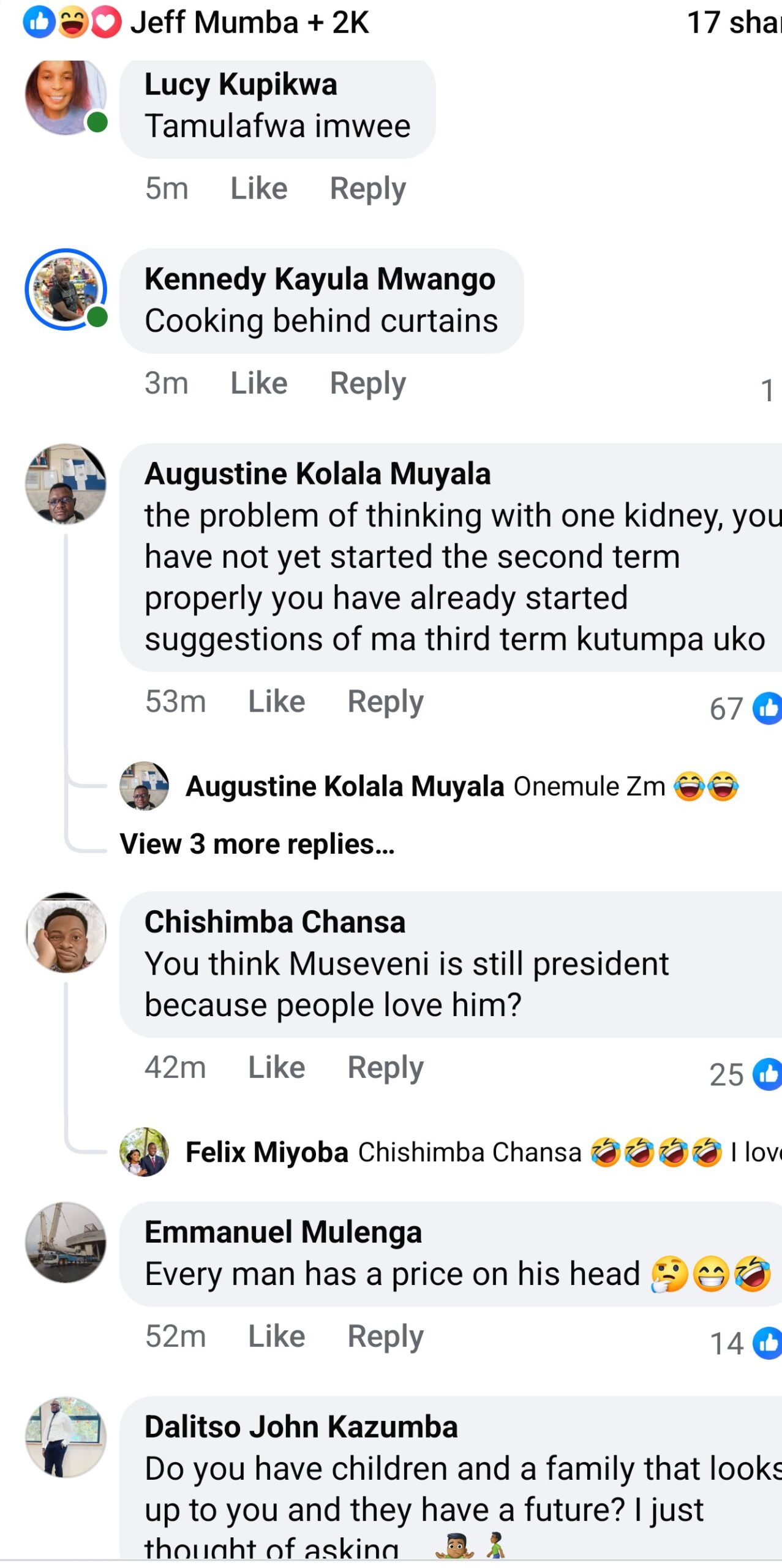
Chishimba Chansa, for instance, asked: “You think Museveni is still president because people love him?”
The debate has historical resonance in Zambia.
In 2001, supporters of then-President Frederick Chiluba openly campaigned for a third term as he approached the end of his second term.
Despite not tabled in parliament the issue gathered debated while pro-third term lawmakers championed calls from political and traditional figures for Chiluba to seek another term.
The third-term campaign ultimately did not result in Chiluba seeking another presidential term, and he handed over power to Levy Mwanawasa after the 2001 election. Parliamentary records later referred to Chiluba as having retired from the presidency.
The issue resurfaced years later during Edgar Lungu’s presidency, when his eligibility to contest the 2021 election became the subject of a constitutional challenge. The Constitutional Court considered whether his first period in office, after succeeding Michael Sata, should count towards the constitutional two-term limit.
The current debate therefore revives a recurring question in Zambian politics: whether presidential continuity should be weighed against constitutional limits on tenure.
For now, the discussion is being driven by political commentary and social media reactions, rather than a formal proposal to amend the presidential term limit.
The debate is emerging at the beginning of Hichilema’s second term, with the president’s current mandate running to 2031.
WARNING! All rights reserved. This material, and other digital content on this website, may not be reproduced, published, broadcast, rewritten or redistributed in whole or in part without prior express permission from ZAMBIA MONITOR.








Comments