
 By
By 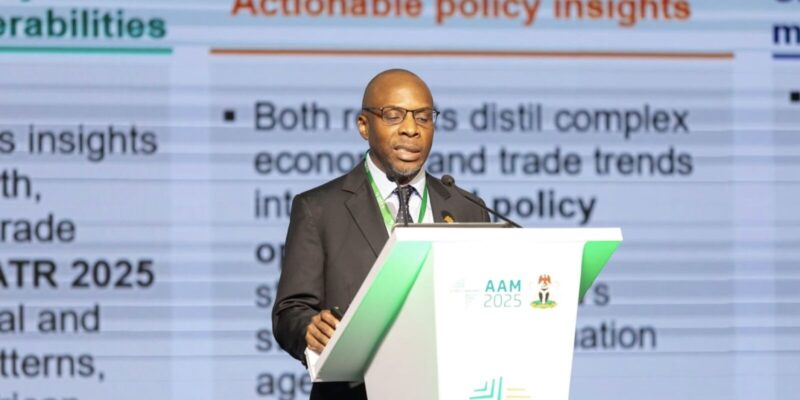
African Export-Import Bank (Afreximbank) has published a report highlighting persistent structural weaknesses in Africa’s trade landscape, warning that the continent’s continued dependence on raw material exports leaves many economies vulnerable to external shocks and global market volatility.
The findings were released in Volume 10, Issue 1 of the bank’s Trade and Development Finance Brief, titled “Africa’s Trade and Investment Landscape”, which examines challenges and opportunities shaping trade and investment across the continent.
According to the report, African exports remain heavily concentrated in agricultural commodities, oil, gas and minerals, while imports are dominated by manufactured goods and machinery. This trade structure exposes many countries to commodity price swings, geopolitical tensions and supply chain disruptions, the report said.
Read more: Afreximbank warns of $100 billion trade finance gap hindering intra-African trade growth
Afreximbank said the African Continental Free Trade Area (AfCFTA) remained central to efforts to diversify Africa’s trade base, strengthen regional value chains and expand intra-African commerce.
The report noted that the AfCFTA, together with the African Union’s Agenda 2063 development framework, offered a pathway to integrate fragmented markets, expand industrial production and boost productivity across the continent. Intra-African exports could rise by more than 20 percent within a decade as implementation progresses.
The publication also underscored the need for greater investment in trade-enabling infrastructure, including energy systems, transport networks, ports, logistics facilities and communications infrastructure.
Such investments could lower business costs, improve cross-border trade flows and strengthen Africa’s attractiveness as an investment destination, the report said.
Beyond infrastructure, the report identified regulatory reforms, stronger institutions, economic diversification, improved access to finance for small and medium-sized enterprises and wider adoption of digital financial technologies as key priorities for strengthening Africa’s trade and investment ecosystem.
It also noted that both domestic and foreign investment were rising across many African economies, although foreign capital continued to dominate overall investment flows. Eastern and Southern Africa currently attract a larger share of foreign direct investment than Western and Central Africa.
“Regional development finance institutions, including the African Export-Import Bank, are playing an increasing role in supporting intra-African trade through trade finance and related initiatives,” said Dr. Yemi Kale, Afreximbank’s Group Chief Economist and Managing Director, Research.
He cited initiatives including the Intra-African Trade Fair, the Pan-African Payment and Settlement System, the AfCFTA Adjustment Fund, the Border Markets Initiative and the Collaborative Transit Guarantee Scheme as efforts aimed at strengthening the continent’s trade and investment ecosystem.
Afreximbank said the findings reinforced the need for coordinated action to expand trade finance, improve infrastructure, deepen regional integration and accelerate value addition across Africa.
The report stated that while progress was being made, significant gaps remained and addressing them will be critical to improving competitiveness, increasing financing and unlocking Africa’s full trade and investment potential.
WARNING! All rights reserved. This material, and other digital content on this website, may not be reproduced, published, broadcast, rewritten or redistributed in whole or in part without prior express permission from ZAMBIA MONITOR.










Comments